
Key Points
Bullet point summary by AI
- A new era begins for American soccer as the USMNT enters the 2026 World Cup with fresh energy and heightened expectations.
- The team features its most talented roster ever and a coach who promises a faster, more exciting style of play.
- Three group-stage matches against evenly matched opponents will test whether this team can finally break through on soccer's biggest stage.
The U.S. begins its journey at the 2026 World Cup on Friday night against Paraguay, and if you're like most of the country, this will be the most attention you've paid to this team since they lost to the Netherlands in the round of 16 back in 2022. There's no shame in that: This is not, historically speaking, a program that has rewarded emotional investment. (Support group meets down the hall at 7; I'll bring the donuts.)
But a whole heck of a lot has changed in the intervening four years, which means there's a lot for you get caught up on if you want to come off like the smartest friend in your group chats. Who are the best American players in this tournament? Who's the new coach? And will this time finally be different when it comes to the U.S. meeting lofty expectations? Here's everything you need to know as the World Cup gets underway.
Who are the biggest stars on the USMNT?

U.S. Soccer has made a concerted effort for years now to make sure that the best American players develop under the best competition, and that effort has born obvious fruit. It's not an exaggeration to say that this is, on paper, the deepest and most talented roster that the USMNT has ever assembled, with several players filling meaningful roles in Europe's top domestic leagues.
There's the midfield duo of Weston McKennie (Juventus of Serie A) and Tyler Adams (Bournemouth of the Premier League), who together might be the single biggest determining factor in how deep this team can go at the World Cup. When McKennie's motor is running hot, he's a truly elite box-to-box midfielder, someone who can dispossess the ball with a physical tackle and then deliver a picture-perfect through-ball all in a matter of seconds. When Adams is healthy — and that's been a big, big if throughout his career — he's the spine of this team's defense, a relentless worker capable of marking the best attackers in the world and shutting down opponent attacks.
There's Antonee "Jedi" Robinson, a physical freak who's slowly but surely developed into one of the Premier League's best left backs for Fulham. He's a menace defending the ball, but he's a genuine two-way threat as well, with a powerful right foot that can whip services into the box and do stuff like this:
Antonee Robinson UNLEASHES 😱 pic.twitter.com/nGjr1voa0q
— B/R Football (@brfootball) June 6, 2026
Opposite Robinson on the right side is Sergiño Dest, a star for PSV Eindhoven in the Netherlands, whose liability (some might say disinterest) as a defender is compensated for by how electric he can be when he's got the ball at his feet. And speaking of which: Winger Timothy Weah, the son of former Ballon d'Or winner George, is a menace in open space; when the USMNT is at its best, they've got Robinson and Weah wreaking havoc on either side with McKennie serving as conductor from the middle of the field.
Of course, for all that top-end talent, there's still one name that looms above all the rest, the one name you probably know no matter how much or how little attention you've paid to U.S. soccer over the last few years.
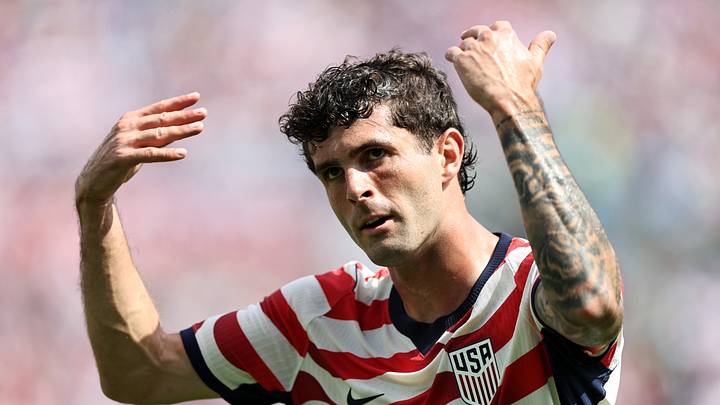
Why is Christian Pulisic such a big deal?

The short answer? Because he's accomplished more at the highest levels of soccer than any other American man before him — the first to both play in and win the Champions League (the most prestigious club soccer tournament in the world) and the first to score in an FA Cup final (essentially England's equivalent of March Madness). All due respect to Landon Donovan, but Pulisic is the most talented player our country has ever produced, an explosive and skilled athlete who scored his first Bundesliga goal before he even turned 18 years old.
The Pennsylvania native spent four years at Chelsea in the Premier League before signing with historic Italian power AC Milan, where he led the team in scoring in 2024-25. At his best, he has world-class speed as a winger (essentially an attacking midfielder, playing higher up the field on one flank in support of the striker in the middle) with endless energy and underrated smarts that create boatloads of fouls and opportunities for teammates.
For as high as the highs have been, there have been lows to match, from injuries in England to a lack of goals this past season in Milan — which, combined with the USMNT's failure to really break through at a big international tournament, have left the sense that the Pulisic era has been more than a little underwhelming. And lord knows the U.S. has seen its fair share of so-called soccer prodigies, most of which have wilted under the intense scrutiny. But Pulisic is as close to the real deal as we've ever come, a genuine star at the highest levels of the sport, and this might be his last chance to prove it to a mainstream audience in his home country. He's frequently saved his best for America's biggest matches; can he do so one more time?
Who is the coach of the USMNT, and why does everyone talk about him?

For pretty much its entire history, the USMNT has been something of a backwater destination for managers. While Jurgen Klinsmann made a splash upon his hiring in 2011, his name was more impressive than his resume — America has never been a place to which in-demand coaching candidates wanted to come.
But that all changed in a big way back in 2024, when U.S. Soccer managed to poach Argentine Mauricio Pochettino to replace Gregg Berhalter. Pochettino came to the States with legitimate accomplishments under his belt, most significantly taking Tottenham to the Champions League final in 2019. He'd also had stops at powers like Paris Saint-Germain and Chelsea, and while neither ended particularly well — there's a reason he was available for America to scoop up — he's by far the most accomplished manager this program has ever had.
He also, unlike the more conservative and staid approach of his predecessors, wants to play a fast and fun brand of soccer. Of course, he's happy to sit back and absorb pressure when his team doesn't have a talent advantage, but if left to his own devices, Pochettino wants his squads to press, push up the field and make life hell on its opponents. Expect a more flexible and exciting team than you're used to, especially considering the talent he has at his disposal.
Just how good is the USMNT?

If you feel like you've gotten your hopes up about USMNTs past only to be let down on the World Cup stage, well, I don't blame you for feeling a bit skeptical. And to be clear, the Americans are far from favorites here: While they have the best odds to win their group, they're +6000 longshots to win the tournament at DraftKings, and they've advanced past the round of 16 in this tournament just once (back in 2002). But at the risk of being Charlie Brown kicking the football one more time ... there really is reason to believe this team is capable of going where no American team has gone before.
It helps to think of the U.S. as squarely in world soccer's middle class: They'll be rightful underdogs against powers like France, Spain, England, Germany and Argentina, but when Pulisic, McKennie, Adams, Robinson and Weah are all in form, that's a level of firepower that the majority of teams in this year's field lack. Pochettino brings a level of tactical flexibility that his predecessors simply did not, and there's more attacking juice here than ever.
If there are weaknesses with this team, they come at the front and at the back, as has been the case for so much of this program's history. Tim Ream is the elder statesman at center back, with over a decade of experience in England, but does he have enough left in the tank at age 38 for the U.S. to still rely on him the way it does on its back line? Will his partner Chris Richards, coming off a tremendous year with Crystal Palace in the Premier League, be 100 percent after suffering an ankle injury in the spring? The U.S. has produced a long line of elite goalkeepers; are Matt Turner or Matt Freese ready to clear that bar? And can Folarin Balogun finally give this team the credible striker it's lacked for decades now?
Those are all holes that will be exploited against elite competition. Then again, the U.S. could plausibly avoid facing said competition until at least the round of 16 if things break right. The Americans have landed in an evenly matched but still eminently winnable group; take care of business there, and a long run could be in store.
How does the World Cup format work?

The World Cup is divided into two stages: the group stage and the knockout stage. To start, the 48 teams are drawn into 12 groups of four. Each team will play every team in its group once, round robin-style, with three points awarded for wins, one point awarded for draws and zero points awarded for losses. The top two teams in each group automatically advance into the knockout stage, with head-to-head results and goal differential serving as the first two tiebreakers should two teams finish with identical point totals. Every third-place team will then be ranked against each other, with the eight third-place teams with the highest point totals (or with the tiebreaker advantage) also moving on.
If all of that seems overly complicated, 1) welcome to FIFA and 2) don't worry, because it's much simpler from here. The 32 teams (24 first- and second-place teams, plus eight third-place teams) who make it out of the group stage will be placed in a single-elimination bracket. While there are draws in group-stage games, that's out the window here — if a knockout-stage match is tied after the full 90 minutes, we'll play 30 minutes of extra time, with penalty kicks to follow if that's still not enough to decide a winner. The bracket will continue from there, from the round of 32 to the round of 16 to the quarterfinals to the semis and all the way to the final at MetLife Stadium on July 19.
Who does the USMNT play in the group stage, and where are the games?

The USMNT finds itself in Group D at this year's World Cup, along with Turkiye (22nd in the latest FIFA World Rankings), Australia (37th) and Paraguay (40th). Here's the schedule for America's three group-stage matches.
- Friday, June 12, 9 p.m. ET: USA vs. Paraguay, Los Angeles
- Friday, June 19, 3 p.m. ET: USA vs. Australia, Seattle
- Thursday, June 25, 10 p.m. ET: USA vs. Turkiye, Los Angeles
Unlike fellow host countries Mexico and Canada, the Americans were done no favors by the draw: While there's no world power here, all four of these teams are relatively evenly matched, with no real safe landing spots. Turkiye boasts top European talent like Real Madrid's Arda Güler and McKennie's Juventus teammate Kenan Yildiz, while Paraguay boasts a physical defense that will earn as many yellow cards as it has to in order to keep you from scoring. Every one of these teams can truly beat any of the others on any given day, but only two or three will move on.
How can I watch the USMNT at the World Cup?
FOX Sports has the U.S. broadcast rights for the 2026 World Cup, and all three of the USMNT's group-stage matches will be broadcast on FOX. If you don't have cable, or if you just want to stream a match on the go, you can do so through the FOX One app, either by connecting your cable log-in or signing up for a subscription. The latter option will cost you $19.99 a month, but FOX is currently offering a three-day free trial.
Looking for an alternative option? Streaming providers like Fubo and YouTube TV also carry FOX, and both come with free trials of their own.
 Add us as a preferred source on Google