
Key Points
Bullet point summary by AI
- A new addition to the Special Olympics 2026 USA Games — cornhole — brings together athletes and fans in unexpected ways.
- The sport's accessibility and strategy make it a powerful tool for unity across generations and abilities.
- Beyond competition, participants share messages of resilience and the importance of treating others with kindness.
For all my Midwest folks, picture this: it's a beautiful 75-degree evening. You're in your backyard with 20 of your closest family and friends. The smell of the grill is in the air.
And of course, the cornhole boards are the place to be.
All it takes is someone to say, "Let's play some bags!" and, from there, the party is on.
It's a game that can bring everybody together.
But, it is also now the newest sport at the Special Olympics 2026 USA Games, and it comes with far more strategy than you might ever think about at your tyipcal family cookout.
Cornhole is the perfect addition to the Special Olympics USA Games
Joshua Brown and Logan Bronkema of the American Cornhole Association took some time out of their busy schedules to hang out with us and offer some insight as to how and why the sport became part of the Special Olympics 2026 USA Games.
Bronkema pointed out that the sport didn't become official until 2003, but 18 years later, the Special Olympics saw an opportunity to help support the sport.
"It started back in 2021 which is when Special Olympics first reached out with us," said Brown. "They were really interested in partnering with us for the rules, specifically ... We play at an official 27 feet, but Special Olympics has rules where you can play as close as 15 feet.
"It's a perfect sport for the Special Olympics."
"I think it's been a great fit," Brown continued. "We're all about cornhole for everybody. You don't have to be a professional to play. You can play in your backyard. You can play somewhere like here at the Special Olympics."
I am sure many of us, as we read this, are nodding and smiling as we think back to our own backyard games. Like Brown also points out, we may have some great memories with so many different family members of different ages.
"It's a sport where three, four generations can be playing the same sport. It's very rare," he said.
Brown wants to continue growing the sport and even mentioned that he and the ACA will send starter kits to any and every state that wants to start participating, which proves their commitment to their mission.
Cornhole brings more than just the neighborhood together at the Special Olympics 2026 USA Games
FanSided was also lucky enough to have a few individuals from Special Olympics Oklahoma spend some time with us and offer their perspective not only on cornhole, but a little on life, overall.
Joseph Schwabe has been coaching for seven years, now, and training for cornhole, this year, presented him with some difficult challenges. Half of his team lived 2.5 hours away, so getting them together for training was no easy task.
11 months of training for Schwabe's team, and they finally took the biggest stage of all.
"I want everyone to know that our athletes love competition, meeting friends this week and enjoying themselves and experience the community and camaraderie," Schwabe said of his team.
Schwabe didn't originally realize Special Olympics was for more than just adults, which seemed to be what drew him to the organization. As a high school football coach and former track coach, he's been able to get a front-row seat to the impact Special Olympics is able to have on young people.
When it comes to the strategy and maybe some thinking cornhole is just a simple game, Schwabe had this to say:
"You aren't only throwing a bag. At one point it must become strategy. You need to see where you are at in-between rounds and if you find your bag not sitting where you want it to be, you want to be either over or under which means either hitting the top of their bag or the bottom of their bag."

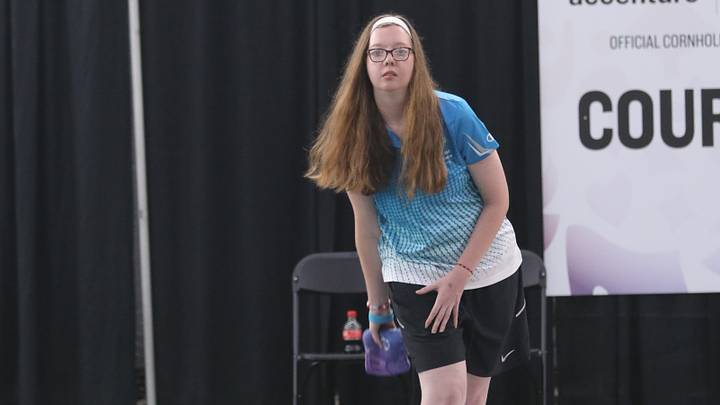
At this year's USA Games, we were able to spend time with Schwabe and one of his athletes, Jaeden Clampett, who also happened to come home with a silver medal at the games.
"Whenever she practices against me, she gets better. And she consistently beats me," said Schwabe.
Clampett was fresh off four gold medals in powerlifting back at the Special Olympics Oklahoma Games in May of this year. She showed incredible talent and versatility competing in cornhole just a month later.
Speaking of versatility, Clampett also has a degree in culinary arts!
Beyond her place as an athlete at this year's USA Games, Clampett left us with a much more important story; one of resilience and a message about love, inclusion and kindness.
Clampett lost both of her parents just a few years ago, and within just two years of each other.
Despite unimaginable tragedy, Clampett is still able to push forward and show the world what she can do.
""When I go out to compete, the number one thing I'm going to do is I'm going to go out there and show the world what I'm capable of," she said.
As for one message she would like the world to know?
"Always treat others the way they want to be treated and think about their feelings before you say something."
Both Clampett and Schwabe talked a little bit about strategy and how their opponents' bags can throw a wrench into each and every round.
"People don't get that playing cornhole is really really hard. Getting the bag on the board just right is really hard. I feel like practice makes perfect. No matter what, just give it your all, but focus on a strategy," Clampett said.
But, going past any of the strategy or game itself, the two of them brought a lasting message with them from Oklahoma.
"Leave everyone with a smile."
Schwabe made sure we knew Oklahoma's message to the world. That's their motto. They came to compete, give it their all, but also to leave everybody with a smile.
Speaking on behalf of FanSided, I can say they undoubtedly succeeded in their efforts.
Why We Play features stories about the power of sports to bring us together, overcome obstacles, make positive change and reach everyone. Read more here.
 Add us as a preferred source on Google