
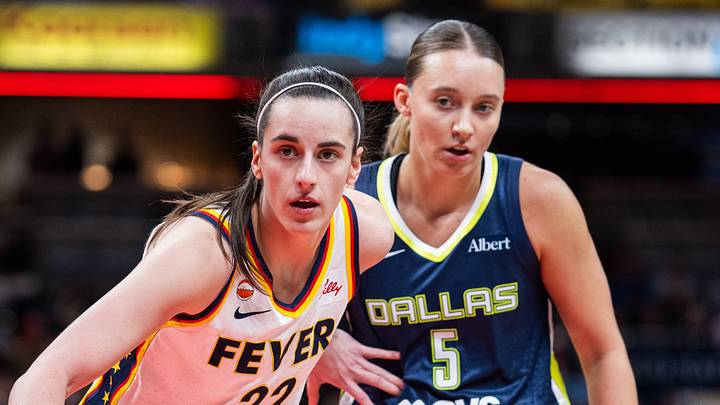
The last two WNBA Rookie of the Year — Caitlin Clark and Paige Bueckers — face off tonight as the Indiana Fever and Dallas Wings jockey for playoff position. The Wings have been sliding in the standings but are still just 1.5 games back of the Fever, who are tied with the Atlanta Dream for the No. 4 seed. Dallas has also already beaten Indiana this season, a three-point win on Opening Night, with Bueckers dropping 20 points on just 10 shots.
These two teams will play again next Thursday, meaning the stakes here are set up recency rivalry, playoff positioning and the personal duel between Bueckers and Clark, who are arguably the two best guards in the WNBA right now. But which one is on top?
Caitlin Clark has never been better
Last season was mostly lost to injuries for Clark — she played just 13 games and clearly wasn't fully healthy even when she was on the court, with her shooting percentages hitting rock bottom. It seems like so little of the discourse around Clark actually touches on her production, which is why it hasn't gotten a lot of coverage that she's taken a big leap this season.
Through 29 games, Clark is averaging 21.7 points, 8.2 assists, 3.9 rebounds and 1.0 steals per game. The biggest evolution has been with her shooting percentages — 44.3 percent from the field, 36.1 percent from behind the line, both career-highs. With her typically accurate free-throw shooting and a career-high 6.5 free-throw attempts per game, her true shooting percentage is at 60.3. If that scoring efficiency holds, she'd be the first player in league history to finishin with a true-shooting percentage above 60, with usage and assist rates over 30.
Clark is still working on her shot selection and the Fever are still figuring out how to best utilize her, Aliyah Boston and Kelsey Mitchell together. But even with those bumps in the road, she's still a uniquely efficient offense engine. And yet, you can still make an argument that Paige Bueckers is better right now.
Paige Bueckers is better in her role

As an offensive engine, Bueckers is absolutely on the same tier. She's averaging 20.2 points, 5.8 assists and 4.1 rebounds per game on 51/39/86 shooting splits. Even with Clark bouncing back this season, Bueckers' shooting percentages are better across the board and getting to the free throw line a bit less often is the only reason she doesn't have a big edge in true shooting percentage — she's at 60.2, a tenth of a percentage point behind Clark.
The difference is that Bueckers plays a slightly more complementary role for her team — her usage and assist rates are 25.2 and 29.5, respectively, compared to 32.5 and 44.4 for Clark. You could argue that efficiency on a higher usage level makes Clark fundamentally more valuable but that obscures the cost of her offensive primacy. Namely, that Clark turns the ball over 20.9 percent of her possessions, more than twice the rate of Bueckers.
Clark is playing with a pair of All-Stars — Mitchell and Boston, who are both prolific scorers in their own right — and a deep cast of optimized bench players. Bueckers' most dangerous offensive teammates are rookie Azzi Fudd and Arike Ogunbowale, in the midst of an abysmal season. Despite that, the Fever offense is only marginally better with Clark on the floor (113.8 points per 100 possessions) than the Wings' with Bueckers on (112.7).
Maybe Bueckers wouldn't be able to maintain her efficiency with a jump in usage, a point in Clark's favor. But it matters that Bueckers has been willing to accept a smaller and more optimized role. In a vaccum, she may not be a better shooter than Clark but shot selection matters. On pure volume, she may produce less offense than Clark, but it matters that she turns the ball over less, that she's more comfortable ceding creation opportunities to Fudd and Maddy Siegrist. It matters that with less talent and less experience, the Wings are still right behind the Fever in the standings.
The elephant in the room

The biggest wrinkle here is that "best guard in the WNBA" is a three-way argument, and Olivia Miles may actually be the winner. The Minnesota Lynx rookie is averaging 19.8 points, 6.1 assists and 4.7 assists per game on 50/40/87 shooting splits, leading what's been the best team in the league by a wide margin. Miles has plenty of veteran help but the Lynx were also without their best player, Napheesa Collier, for more than half the season.
If you loosen those usage and assist rate thresholds to include players above 25 with a true shooting percentage above 60, you get Bueckers AND Miles — who has a better true shooting percentage than either Clark or Bueckers. (You also get historic seasons from Cynthia Cooper, Kelsey Plum, Tamika Catchings, Diana Taurasi and Cappie Pondexter.) She's not as prolific as a 3-point shooter but Miles has found a way to be more efficient than either, while creating a similar level of offense for her teammates AND being far superior at the defensive end of the floor.
So Bueckers may be better than Clark. But Miles may be better than both ...
 Add us as a preferred source on Google