
The 12-team College Football Playoff era, we will miss you. It’s seemingly the perfect number of teams to juice rivalry week with incredible stakes, so we can simultaneously watch Auburn and Washington ruin (at least potentially in one case) Alabama and Oregon’s seasons on their home fields. It was a beautiful holiday weekend of college football, and because of those two upsets and a few other results, the CFP picture is about as clear as it could possibly get.
Essentially, as I and the sportsbooks who set wagering odds on such things see it, there are, charitably, three teams for one at-large spot: Iowa, Alabama, and USC (if we’re being charitable). Georgia, Utah, Texas, Notre Dame, Tennessee, and Miami have their odds off the board. BYU and Wake Forest are sitting at -20000, Texas Tech is -1100, and Indiana is -630 to beat UCLA in the Big Ten Championship Game. So the field is basically set because it’s unlikely that the loser of the Big Ten Championship Game could get an at-large.
In the other 3 Power 4 leagues, the championship games feature two teams already, seemingly, locked into the field: Georgia and Texas, Miami and Wake Forest, and Utah and Texas Tech. So, the Big Ten is where the drama lies.
1. Hank Brown’s legs have unlocked Iowa’s offense

- First course: A 31-7 Heroes Game beatdown from the Hawkeyes in Iowa City
- Tasting note: A familiar favorite with a tiny bit of extra spice
- The takeaway: Iowa is playing classic Iowa football right now, but playing it the best the Hawkeyes have since 2015, when Kirk Ferentz nearly led his team to the four-team CFP. Now, he’s got a better case than anybody would expect to make the 12-team CFP in its final year.
Over the first nine games of the season, seven of which were started by Hank Brown, Iowa’s offense was serviceable, which is about all you could ever ask for from a Kirk Ferentz-coached team. Recently, as the Hawkeyes have made their case as a College Football Playoff team and carved their path to the Big Ten Championship, they’ve unlocked something new by using Hank Brown’s legs.
Hank Brown | Weeks 1-10 | Weeks 11-13 |
|---|---|---|
Rush ATT | 27 | 30 |
Rushing yards | 51 | 112 |
Rush TDs | 2 | 5 |
Designed rushes | 3 | 7 |
Total rushing EPA | 3.65 | 20.2 |
EPA/rush | 0.14 | 0.67 |
Brown ran for 48 yards and three touchdowns on 12 carries against Nebraska. Only eight of his rushing yards came as a scrambler. Adding the element of the QB run game has been especially valuable in the red zone, where Iowa averaged 6.0 points per trip against Nebraska, averaged 4.0 per trip against Illinois in Week 12, and averaged 7.0 points per trip in the Week 11 win over Purdue.
That’s massive for an offense that, on the season, ranks No. 77 in the country, converting just 91.9% of its trips to the opponent’s 20-yard line into either a touchdown or a field goal attempt.
Under Ferentz, the Hawkeyes have always managed field position well, won the turnover battle, as they did against Nebraska, converting Anthony Colandrea’s fumble and a muffed punt into 14 points on Friday, and played defense in a way that shrinks the game. If you can pair all that with an elite red zone offense, you can have something special, and lately, with Brown running wild, that’s what Iowa has.
2. It took Lincoln Riley to finally solve UCLA’s defense

- Second course: An old-fashioned Lincoln Riley blowout win for the Trojans 45-10
- Tasting note: The type of loss that’s tough to swallow for UCLA when it appeared to have the upper hand on its cross-town rival with a 10-0 start
- The takeaway: UCLA still has a chance at the CFP, playing Indiana in the Big Ten Championship Game next week, but after Michigan took down the Bruins, USC laid out a clear blueprint for answering DC Colin Hitschler’s blitz-heavy approach.
One of the real secrets to UCLA’s defensive success this year, a unit that came into the week No. 7 in the country, allowing just 1.21 points per drive, and No. 6 at -0.24 adjusted EPA/play, was how aggressively Hitschler attacked heavy personnel groupings and condensed formations. Through the 10-0 start, UCLA was blitzing at a 67% clip against 12-personnel groupings, something USC doesn’t typically utilize a ton of, but featured constantly in Week 13.
Knowing he could get Hitschler into those blitz looks, often targeting the A- and B-gaps, Riley seemed to feel he had an advantage getting to GT counter, split-flow zone runs, and pin-pull type runs that change the leverage point for the defense. He also utilized direct snaps to running backs out of those looks to feature more 11-man run game than Jayden Maiava provides to either slow the often blitzing linebackers’ pursuit or add an extra gap with an insert, which threatens to spring the runner into the secondary if linebackers commit downhill too early and vacate the second level.
All three of Waymond Jordan’s touchdown runs came out of 12-personnel. Through three quarters, as USC built a 35-3 lead, the Trojans were at a 58% rushing success rate and 0.23 EPA/rush. The final numbers aren’t as gaudy, but the success was obvious watching the game.
Waymond Jordan's got his second TD of the day 🤩 @uscfb
— Big Ten Football (@B1Gfootball) November 28, 2026
Watch on CBS pic.twitter.com/IdY7CE4SHS
The counter runs were my favorite from USC because that was long an underrated staple of Riley’s dominant offenses at Oklahoma, and there haven’t been many instances where his offenses have been able to push a defense around since he arrived in LA.
The UCLA offense is hanging by a thread. Ty Dieffenbach couldn’t move, and that’s a problem with an offensive line that is allowing a ton of quick pressure. But that UCLA’s defense was pushed around in such an intentional way probably means that this Cinderella run is just over.
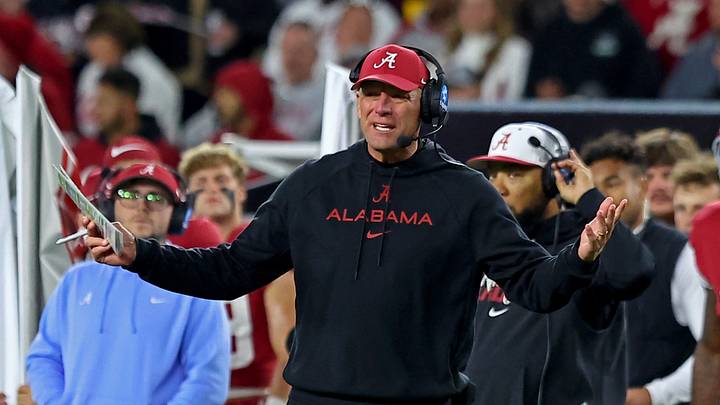
3. Alabama’s offensive line issues still aren’t fixed

- Third course: A rare even-year Iron Bowl win for Auburn, 30-23
- Tasting note: “Bubble” gum
- The takeaway: There’s been plenty of room in the CFP discussion for a three-loss SEC team to make the field, but this particular three-loss SEC team may not have enough on its resume to justify inclusion. And even if they do squeak in, the Crimson Tide have too many problems up front to do real damage.
When Auburn beat Georgia, a week after the Bulldogs’ war with Alabama, they did it with a 2.7% postgame win expectancy according to ESPN’s Bill Connelly, and had a -10.6% net success rate. That win was a fluke powered by Gunner Stockton’s turnovers. This win had a few Keelon Russell turnovers, but was nothing like that game.
Auburn had a +7.1% net success rate edge, and according to gameonpaper’s post-game win expectancy model, which doesn’t always mirror SP+ but is a similar type of stat, Auburn had a 98% deserved win percentage. That’s massive.
Alabama’s offensive line was responsible for seven of the team’s eight accepted penalties in the game. Center Racin Delgatty was particularly sloppy in that regard, including an illegal snap on third-and-goal from the one that backed Alabama up to the five and led to a field goal. The entire line allowed consistent pressure on Keelon Russell, though he remains at fault for one of the slower internal clocks among starting QBs in college football, and a few pre-snap protection issues that led to free runners.
On the ground, the Tide managed just a 41% rushing success rate, with a non-explosive EPA/rush of -0.23, and an 18% stuff rate. That continues a stretch of poor rushing performances, even if it did ultimately finish at 0.08 EPA/rush on the back of Daniel Hill’s two explosives. As was the case last season, Alabama has become one-dimensional again, putting too much on its quarterback who is under pressure too often. It’s not a great formula and could lead Kalen DeBoer to finally sever his connection with longtime OC Ryan Grubb.

It’s not that it’s a bad run game; it’s just that it’s not a good run game, especially when you strip out explosives. That was pretty hard to imagine when you watched this offense at the beginning of the year and recognized the stress Russell’s legs put on defenses relative to last year’s Alabama offense with Ty Simpson, and the baseline of value he provided as a scrambler, which hasn’t really gone away.

As for the CFP picture, it really might be as simple as 9-3 Alabama with no ranked wins in the final rankings (unless Kentucky sneaks in after beating No. 19 Louisville on a walk-off field goal) and losses to Georgia, Tennessee, and Auburn vs. 10-2 Iowa with no ranked wins in the final rankings and losses to Ohio State and Minnesota.
In Week 6, Alabama looked like the second-best team in the country; Iowa has never been that. But right now, at least, Iowa is playing better football.
4. It all really was just too much for Oregon to overcome

- Check, please: When it’s clear there won’t be a seat for you at the CFP table, it’s time to pay your check and leave
- The cost: A chance to roll into the Big Ten Championship and potentially the CFP as the hottest team in the country.
I made Oregon pay its check and leave after its third loss of the year, falling to Illinois’s backup quarterback. It felt safe to say the season was over at that point, but to Dan Lanning’s credit, the Ducks rallied and turned into the hottest team in the country down the stretch.
But the thing about a margin for error is that eventually, it just runs out. Oregon used up most of it early, so it couldn’t afford to have a doinked extra point at the end of regulation after tying the game against Washington or a missed field goal in the first overtime, before the Huskies finally ended it 33-27 with a score and a stop in the second OT period.
Ultimately, Oregon had an 11.6% net success rate edge, averaged 6.00 points on its four red zone trips to Washington’s 5.67 points on its three red zone trips, and was +5.0 turnover luck points per GameOnPaper for recovering both of its own fumbles. Even with an onside kick gone wrong, Oregon’s average field position of its own 40-yard line was better than Washington’s at its own 34-yard line.
Aside from a few questionable pass interference penalties that went Washington’s way, Oregon had every reason to win this game. Sometimes a result like this happens, so you better hope you didn’t spend your margin for error before it does.
5. Wake Forest is in the CFP no matter what happens in Charlotte

- Reservation: The season isn’t over yet, but this team has all but locked up a spot in the CFP
- Booking: It took Wake Forest a while to get going, but the Demon Deacons woke up in the second half after leading 10-7 at the break to pull away for a 31-7 win over Duke and an 11-1 regular season finish.
- Cancellation policy: With the way the bubble broke, knocking out Oregon and forcing a debate between 9-3 Alabama and 10-2 Iowa, with even some consideration potentially paid to 9-3 USC, Wake Forest is locked into the CFP field regardless of how the rematch with Miami plays out.
In previous years, we’d be talking about how Wake Forest is already a complete lock to make the CFP field because the committee is afraid to ruin the conference championship games by punishing a team for losing and allowing another team that was idle during conference championship weekend to grab the spot instead.
This year, with the 24-team expansion coming in 2027 and conference championship games going away, the committee doesn’t have to worry about precedent. Last year, BYU was in a similar situation as Wake Forest is, playing a rematch against the only team that had beaten it in the regular season, and BYU did move down after looking non-competitive against Texas Tech, but the Cougars were already out of the field heading into the weekend.



Wake Forest is in, and even without the threat of precedent, the committee wouldn’t dare drop the Deacs all the way out because there’s no team with a resume good enough to replace them with.
6. BYU is a stone-cold lock with its Notre Dame win in the back pocket

- Reservation: The season isn’t over yet, but this team has all but locked up a spot in the CFP
- Booking: Few teams have a trump card like BYU’s win over Notre Dame; it’s simply one of the best wins of the season, and with the Cougars idle as Texas Tech plays Utah for the Big 12 title next week, the 10-2 Cougars have gone to -20000 odds to make the CFP field.
- Cancellation policy: There really isn’t a scenario where enough teams would jump ahead of BYU with its resume complete after a 42-10 demolition of Cincinnati.
With a healthy LJ Martin back in the lineup, BYU’s offense has become terrifying. The Cougars needed overtime to score 31 in a win over Kansas last week, but the scoreboard didn’t reflect how positive the underlying metrics were, generating the highest EPA/play (0.18) and offensive success rate (47.8%) since a Week 6 win over Iowa State.
Against Cincinnati, which, in fairness, is one of the worst defensive teams in the Big 12, BYU’s offense went nuclear: 0.45 EPA/play (98th percentile), 58% success rate (96th percentile), 9.36 yards/play (99th percentile), 11% explosive play rate (85th percentile), and 70% third-down success rate (97th percentile).
It was one of the best offensive performances of the season, not just by BYU, but by any offense, and Bear Bachmeier, after struggling recently, went 21-for-28 for 332 yards and three touchdowns. The difference is the number of single-high safety looks Bachmeier is seeing now and how aggressively defenses are blitzing to slow down the run game.
Bear Bachmeier vs. Blitz | With healthy LJ Martin (10+ carries this season) | W/o healthy LJ Martin |
|---|---|---|
% of dropbacks | 67.9% | 36.7% |
Completion% | 63.9% | 48.3% |
YPA | 8.5 | 5.8 |
TD/INT | 4/1 | 5/5 |
Time to throw | 2.62 | 2.51 |
Pressure-to-sack | 26.3% | 3.4% |
7. Indiana is finally realizing Charlie Becker is its easy button

- Head of the table: The best individual performance of the week earns a seat at the head of the table
- The resume: 5 rec, 129 yards, 2 TDs, 1 rush, 22 yards, 1 TD
- The takeaway: Indiana is back to Josh Hoover, and against a putrid Purdue defense, rediscovered that Charlie Becker is the easy answer that this offense forgets about far too often.
Charlie Becker is No. 4 in the country in yards per route run at 3.71, behind Malachi Toney, Jeremiah Smith, and Carlos Hernandez. He’s an efficiency monster in a lower passing volume offense, seeing over 30% of his targets come over 20 yards downfield. That’s a great way to use a burner at 6-foot-4 who dominates the catch point.
However, in Week 13, Indiana just found more ways to get the ball into his hands, including on a jet sweep, and was rewarded for it. Becker is an easy button for this offense, clearly its best player, yet he’s No. 34 in the country in targets and has just a 31.9% target share, nearly 5% behind Smith and about 6% off Illinois’s Collin Dixon.
Funnelling your entire passing game to one player isn’t necessarily optimal, especially when you have a player like Nick Marsh playing opposite Becker. But his usage needs to increase next week in the Big Ten Championship Game and, presumably, in the CFP, because he’s proven he can handle the volume without sacrificing efficiency.
8. Texas Tech has the scariest play-action passing game in the country right now

- Hors d’oeuvres: A little something to chew on from the week that was in college football
- Nutrition facts:
- Tommy Castellanos w/ PA since taking over as the starter in Week 9: 31/40, 555 yards (13.9 ypa), 11 TD, 1 INT
- 13.9 ypa is No. 1 in the country during that stretch
- TTU O 20% explosive pass rate vs. TCU in Week 13
- Castellanos averaged 13.36 yards/dropback and 0.76 EPA/DB in Week 13
Tommy Castellanos is a very unique quarterback. He’s not a traditional dropback guy because of his size; he doesn’t see the field especially well, and even beyond that, historically, he’s not a great decision-maker. Still, he’s a dynamic athlete at the quarterback position with rare dual-threat ability and a live arm when throwing on the run.
If you build the right offense for him, that skill set will absolutely play, and Texas Tech OC Mack Leftwich has figured it out. Even when he doesn’t use play-action, which he’s utilizing on about 35% of Castellanos’s dropbacks, he presents the run-pass conflict by getting Castellanos outside of the pocket, which creates one-on-ones down the field.
No team has a scarier play-action threat than Texas Tech right now.
— Josh Yourish (@JYourish3) November 29, 2026
Tommy Castellanos w/ PA since Week 10:
21/27, 394 yards (14.6 ypa) 10 TD 0 INT
TTU O 20% explosive pass rate vs. TCU in Week 13 pic.twitter.com/p2oYcf9vGr
It was a brilliant game plan from Leftwich, and it yielded chunk play after chunk play. Texas Tech is playing Utah in the Big 12 Championship Game, but even with a loss, I think you can argue this team belongs in the field and would be a real threat. Though I’m not writing it off that this team is going to lose in Dallas by any stretch of the imagination.
9. Marquise Lightfoot is reaching a ridiculous level for Miami at the right time

- Hors d’oeuvres: A little something to chew on from the week that was in college football
- Nutrition facts:
- Lightfoot recorded 2.5 sacks and 2.5 tackles for loss vs. Boston College
- Lightfoot finished with a 35% pass-rush win rate with 7 pressures on 20 pass-rush snaps
- It was Lightfoot’s 2nd 7-pressure game of the season (UNC)
- He’s now top 20 in the country among EDGEs with 43 total pressures
I’ve said in the past that I have some structural concerns about Miami’s run defense, due at least in part to its edges, including Marquise Lightfoot. At 235 pounds, he’s not exactly Rueben Bain setting the edge, but when he can pin his ears back, he’s a terror. He was for Boston College in Week 13.
Miami didn’t just pressure Mason McKenzie on half of his dropbacks on Saturday; they sacked him on 19.2% of them. McKenzie averaged 0.92 yards per dropback, which is a 0th-percentile output. It’s just Boston College, but the Miami pass rush is terrifying right now, and Lightfoot is leading that charge.
10. Will Muschamp was brought to Texas to beat Georgia, and now he has his chance

- Dessert: Whether it’s a rich play design or a decadent athletic display, here’s a sweet football treat
- Tasting note: A near-perfect culinary experience from a man Louis Riddick wouldn’t trust to buy groceries
Bob Wischusen and Louis Riddick were on the call for Texas’s ugly 16-6 Lone Star Showdown win at Kyle Field and told a story about how Will Muschamp’s wife knew he needed to get back into coaching when he started to ask her what she needed from the grocery store. Riddick then commented that he’s not sure Muschamp is the type of husband to bring back the right stuff from a grocery store trip.
That might be fair. When he was responsible for the whole meal as a head coach, Muschamp couldn’t handle it, but as a sous chef in Austin, running the defense with the best ingredients around, he’s been near perfect. Texas A&M, granted without much at wide receiver and down to its backup QB, Brady Hart, didn’t reach the red zone once on Friday night and averaged just 3.8 yards per play. Of course, that was better than the Arch Manning-led Texas offense, but that’s another story for another day.
Muschamp hasn’t been blitzing at a super high rate, more often relying on the tremendous talent he has up front. But his defensive line has been stunting at a high rate, something Pete Kwiatkowski didn’t do much of, and it’s been working beautifully.
The Justin Cryer sack was the exact same look, both offensively and defensively, in the presnap. Same stunt called both times by Will Muschamp, but the 2nd time, #Texas gets home.
— CJ Vogel (@CJVogel_OTF) November 28, 2026
First play was 3rd & 7 with 6:08 in 1Q. DPI was called.
Second play 3rd & 7 with 0:38 in 3Q.… pic.twitter.com/kJobhuhF8u
11. The Pac-12’s Colorado State blood sacrifice seems to have worked

- Kid’s menu: The CFP saves one spot at the big kids’ table for the Group of Six
- The takeaway: The Pac-12 sent Boise State to Fort Collins for its Flex Week, ahead of a rematch with San Diego State in the Pac-12 Championship Game, and after an early scare, the Broncos rewarded that decision with a 49-28 win.
Colorado State led 14-0 and 21-7 over Boise State thanks to a surprise onside kick, but the worst defense in FBS football in quite some time left the floodgates open, allowing Boise State to score a touchdown on seven of its 10 drives.
Boise State’s defense has been alarmingly bad lately as well, and allowed a remarkably efficient performance to Hauss Hejny and the Colorado State offense. That might be a concern for the CFP committee, but it seems Boise State has a considerable lead over the rest of the G6 field. So while the G6 bid doesn’t have to come from a conference champion, if they can close the deal and avenge last week’s loss to San Diego State next week, the Broncos will be back in the playoff. Though not as a top-four seed this time.
12. Louisiana Tech drops the Sun Belt out of CFP consideration

- Kid’s menu: The CFP saves one spot at the big kids’ table for the Group of Six
- The takeaway: By dropping the first of back-to-back matchups with Georgia Southern, 41-3 in Stateboro, Louisiana Tech removed itself from CFP consideration in case the Pac-12 and American both descend into chaos.
Louisiana Tech entered Week 13 locked into the Sun Belt Championship Game against Georgia Southern with a 9-2 record overall and both losses to Power 4 opponents, LSU and Baylor. Likely, in the 12-team format, a Sun Belt team needs to be an undefeated conference champion, as James Madison was last year with a lone loss to Louisville.
So, Louisiana Tech, with two losses, probably wasn’t going to push up high enough to be the answer if Boise State, UTSA, or New Mexico faltered, but if the Bulldogs pounded Georgia Southern twice in a row, that would be quite a compelling case to be next up behind the Broncos. Now, that ship has completely sailed, as Sonny Cumby’s team looked content to put nothing on tape before Round 2, with much more at stake next week.
 Add us as a preferred source on Google