
Key Points
Bullet point summary by AI
- The NCAA regionals delivered chaos as half the national seeds fell short and two historic four-seeds advanced for the first time since 1999.
- This weekend's results will dramatically reshape the 2026 MLB Draft landscape, creating both opportunities and setbacks for top prospects.
- Several players seized the moment to elevate their draft stock while others face questions that could alter their professional trajectories.
Take a deep breath, everybody. One of the wildest regional weekends in recent NCAA Tournament history saw fully half of the 16 national seeds fail to make it through to Super Regionals, while two different four-seeds (St. John's and Little Rock) advanced for the first time since the current format was adopted in 1999. It was an absolute blood bath, and it didn't just affect the race for the College World Series — it also has the potential to flip the 2026 MLB Draft on its head.
Some of the biggest names in this year's class are now headed home much earlier than expected, while other risers have a chance to make their case to scouts on the biggest stage. Who are the big winners and losers ahead of Super Regionals next weekend?
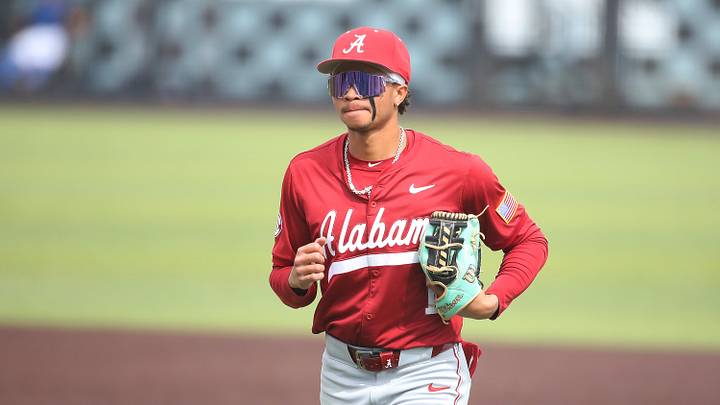
Winner: SS Justin Lebron, Alabama

It's been a winding road for Lebron, who was in No. 1 overall conversations as recently as a few months ago but has seen his stock dip a bit amid a turbulent 2026 season. He entered the Tuscaloosa regional with as much to gain (or lose) as any prospect in this class, and he responded by banging out six hits, two homers and two steals across three Alabama wins.
The physical tools are obvious, and droolworthy; if Lebron can use the Super Regionals (and beyond?) to ease concerns about his plate discipline and hit tool, he could find himself comfortably inside the top 10 when all is said and done. This past weekend was a tremendous start.
Loser: SS Roch Cholowsky, UCLA
Cholowsky is far from the only reason that UCLA went from wire-to-wire No. 1 to flaming out of their own regional. But tallying just two hits across 12 at-bats against St. Mary's and Virginia Tech pitching staffs that are hardly world-beaters certainly didn't help, and will only add to the sense that the most high-profile prospect in this class is starting to lose his grip on the No. 1 overall pick. To be clear, the White Sox won't be making that decision based on a three-game sample, and Cholowsky's broad base of skills and pro-ready game still make him the favorite to go off the board first. But if you were already inclined to believe that high school shortstop Grady Emerson was the more compelling upside play — as members of Chicago's front office reportedly are — well, nothing about last weekend would've changed your mind.
Winner: SS Grady Emerson, Fort Worth Christian (TX)

At this point, the only real hole you can poke in Emerson's game is that prep bats are by definition a more volatile demographic. But the DFW product has it all, a polished bat with legit pop who should have no problem handling shortstop at the big-league level once he matures. If anything, his physical tools give him a higher ceiling than Cholowsky, and the latter's recent struggles have opened the door for him to go No. 1.
Loser: SS Tyler Bell, Kentucky
Bell did everything he could to try and carry Kentucky out of the Morgantown regional, including a heroic two-homer effort against the hometown Mountaineers in a heartbreaking loss on Sunday night. But ultimately, it wasn't enough, and now Bell might well need to undergo surgery on his non-throwing shoulder after playing through injury for much of this season. That probably won't impact his draft stock all that much in the long run, but he had a chance to crash the top 10 with a strong close to this year.
Winner: San Francisco Giants

Three bad games almost certainly haven't talked Giants executive Buster Posey out of his rumored love affair with Cholowsky, and while it's still unlikely that the shortstop falls all the way out of the top three, it's at least more likely than it was this time last week. San Francisco has the money and the draft capital to try and float Cholowsky to the No. 4 spot with promises of a massive bonus; will teams like the White Sox and Rays oblige?
Loser: INF Chris Hacopian, Texas A&M
Hacopian entered the College Station regional as one of the more divisive prospects in his class, both due to his ultimate defensive home (second base? left field? first base?) and due to unique swing mechanics that produce a lot of ground balls and are bound to put off some scouts and front offices. Hacopian, and the Aggies offense as a whole, got off to a tremendous start to regionals, lighting up Lamar and Texas State. As the competition ramped up against USC, though, he disappeared, going 1-for-7 as A&M dropped two in a row to crash out of the tournament. Don't be surprised if he ultimately winds up in the back half of the first round.
Winner: RHP Jackson Flora, UC Santa Barbara

The Gauchos didn't make it out of the Austin regional, but Flora did his part, firing 7.2 innings of one-run ball while striking out nine in a win over Holy Cross. The big righty had already begun to separate himself as the top college pitcher in this draft class. But that's set in stone now, both because of his own performance and because of how his competition fared over the weekend.
Loser: The other big college arms
Florida's Liam Peterson laid an egg against Troy, allowing nine runs on 10 hits in five innings as the Gators failed to get out of the Gainesville regional. Cameron Flukey pitched well over 3.1 innings against Florida State, but with Coastal Carolina eliminated, he won't have the chance to prove that his rib injury is fully behind him and make a statement against elite competition. Ditto for Arkansas' Hunter Dietz, who missed almost all of 2024 and 2025 due to injury and could have really used the chance to add another line item to his resume. All three should still hear their names called within the first 20 picks or so, but they had the chance to climb even higher with a deep tournament run.
Winner: OF Aiden Robbins, Texas

With Drew Burress and Caden Sorrell eliminated and Derek Curiel and Sawyer Strosnider failing to make the tournament entirely, Robbins and AJ Gracia are the last of the top college outfielders still remaining. And the former was white-hot during the Austin regional, banging out six hits and eight RBI with three homers across Texas' three wins. Robbins isn't overly athletic, which will put a lot of pressure on his bat in pro ball, and there remain questions about whether his new power-centric approach will lead to contact issues up the ladder (he did whiff three times against Santa Barbara). If he keeps hitting like this, though, he'll be a lock for the first round.
 Add us as a preferred source on Google