
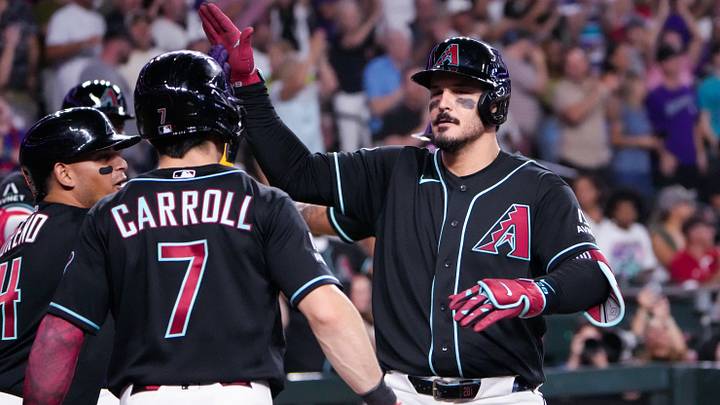
With roughly 30 hours remaining in the 2026 MLB season, the final National League Wild Card berth comes down to a team that fired its manager in April and a team whose All-Star second baseman went missing during a road trip.
Kudos to the Philadelphia Phillies and Arizona Diamondbacks for keeping things interesting. Don Mattingly’s reeling Phillies entered Saturday with a one-game lead over Torey Lovullo’s Diamondbacks, who have won six straight.
Much has changed since Philadelphia held a 6.5-game lead over Arizona on Sept. 1, one day after Diamondbacks second baseman Ketel Marte returned from his controversial absence. Arizona has won 13 of its last 22 and continues to take advantage of the Phillies enjoying a Mets-like collapse.
“You feel the pressure,” Diamondbacks shortstop Geraldo Perdomo said after Friday’s win over the Padres. “But right now, I don’t feel like anyone is feeling pressure [on our team]. We’re just having fun and going out there and trying to win a game.”
The Diamondbacks close with two more games against the Padres in San Diego, while the Phillies host the AL-best Rays in what once looked like a potential World Series preview. Instead, Tampa Bay dealt a significant blow to Philadelphia’s playoff chances with a 2-0 win on Friday night.
In the past, we’d be looking at a Game 163, win-or-go-home scenario if the Phillies and Diamondbacks end Sunday with the same record. However, Major League Baseball eliminated that longstanding tiebreaker upon implementing the expanded playoff format ahead of the 2022 season.
How can the Arizona Diamondbacks make the MLB playoffs over the Philadelphia Phillies?

For those unfamiliar with the newer rules, the first tiebreaker is head-to-head record. That wouldn’t apply here because Arizona and Philadelphia split the season series three games apiece. The obvious solution, at least for the Diamondbacks, is winning their last two games and hoping the Phillies lose out to the Rays.
But what happens if the Phillies win only take one of two from the Rays? In that case, the Diamondbacks must win both games to guarantee a tie for the No. 6 seed. Arizona would then earn the No. 6 seed because they have a better intra-divisional record.
Objectively, we’re not sure why the league didn’t pick intra-league record as the second tiebreaker. Then again, Arizona entered Saturday night 62-50 against NL teams, and Philadelphia finished 62-52, so that tiebreaker wouldn’t matter if the Diamondbacks drop both games to the Padres.
If and when MLB addresses their playoff format, we suggest that intra-league records move into that second tiebreaker spot. Arizona theoretically has the advantage because of playing 26 combined games against Colorado and San Francisco, which should be irrelevant when determining the final Wild Card seed. (Credit to the Diamondbacks, though, for going 19-7 in those games).
The No. 6 seed would play the No. 3 seed Braves during the best-of-three Wild Card Series. Whoever wins that series then gets Shohei Ohtani, Tarik Skubal and the No. 2 seed Dodgers in the NLDS. Good luck!
 Add us as a preferred source on Google