
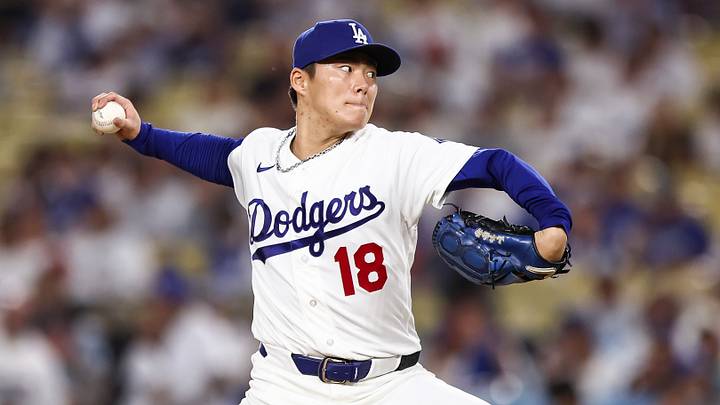
The Los Angeles Dodgers loom large over upcoming CBA negotiations, with owners gunning for a salary cap while players battle to maintain maximum earning potential. The Dodgers, in active pursuit of their third-straight World Series title, own MLB's highest payroll at $380.5 million. That includes $30 million-plus allocated to Shohei Ohtani, Blake Snell, Tyler Glasnow, Tarik Skubal and Mookie Betts on an annual basis.
The Dodgers' ability — and willingness — to outspend opponents, sometimes almost four-to-one, has frustrated fans and given cheaper owners an excuse to cry foul. While the Dodgers experienced their share of turbulence this season, this team clearly isn't going anywhere. Their profits more than make up for their expenses. Look no further than jersey sales:
MLB's top 10 jersey sellers in 2026

The Dodgers have four of the top-10 jersey sellers in MLB this season. That does not include marquee names like Kyle Tucker (acquired last offseason), Tarik Skubal (acquired at the trade deadline) or their other two-time Cy Young winner, Blake Snell.
Player | Team |
|---|---|
1. Shohei Ohtani | Los Angeles Dodgers |
2. Aaron Judge | New York Yankees |
3. Pete Crow-Armstrong | Chicago Cubs |
4. Ronald Acuña Jr. | Atlanta Braves |
5. Fernando Tatis Jr. | San Diego Padres |
6. Freddie Freeman | Los Angeles Dodgers |
7. Bryce Harper | Philadelphia Phillies |
8. Mookie Betts | Los Angeles Dodgers |
9. Yoshinobu Yamamoto | Los Angeles Dodgers |
10. Juan Soto | New York Mets |
In 2025, the Dodgers became the first team in baseball history to generate over $1 billion in gross revenue. While owner Mark Walter's financial troubles made headlines in recent weeks, his troubles are concentrated in the business world, not the baseball world. The Dodgers are an unequivocally profitable venture; not the sort Walter is likely to relinquish any time soon.
There's a reason the Dodgers are willing to spend on premium free agents every winter. It's not because Walter loves baseball and wants to win. Perhaps that is a part of the equation, but baseball, now more than ever, is a business. And the vast majority of ownership groups view it through that cold, inflexible lens. The Dodgers spend money to make money. They fill out the stadium, sell jerseys and rake in merchandise money from all across the globe. Their roster's strong international presence, spearheaded by Shohei Ohtani and his fellow countrymen, plays no small part in that.
Also helpful: so much of L.A.'s salaries are deferred. Ohtani is making $2 million per season through the duration of his contract. He's making the same money as an unproven third-year player still under arbitration.
The Dodgers' dominance will press on — with or without a salary cap

The Dodgers are not going anywhere. Even with a salary cap. It's a sobering truth, but one all 29 opposing fanbases must accept, lest their dreams be shattered further on down the line.
That's not to say the Dodgers are unbeatable. They will eventually fall in the postseason, perhaps as soon as next month. Plenty of great organizations find ways to build competitive rosters without approaching $400 million in spending. Conversely, a high payroll does not guarantee success. Ask the last-place New York Mets, whose $349 million payroll ranks second in MLB, behind only L.A.
Los Angeles is certainly a unique case study, however. Not only are the Dodgers willing to spend, but stars clearly want to play for them. There's the allure of Hollywood. The desire to play for a world-class organization, with top-notch facilities and a great support staff. There is also, more plainly, the desire to win championships. No team in recent history is more consistently in the World Series mix than Los Angeles.
Moreover, the Dodgers just know how to run a successful organization. That is overly broad and simplistic, but it's the truth. Beyond their high-paid stars, L.A. has the best farm system in baseball, with six prospects in MLB Pipeline's Top 100. And that's after trading two top-100 prospects for Tarik Skubal. L.A. has the depth of talent behind their stars to consistently trade for upgrades at positions of need — or to develop cheaper stars to backfill "holes" in their expensive lineup.
While a salary cap would limit L.A.'s ability to sign the Shohei Ohtani, almost their entire core is locked up for the foreseeable future. Those who aren't (see: Skubal) would no doubt love to re-sign. If MLB puts a cap on deferred money, sure, that'll impact their future plans. But Los Angeles would gladly spend more money upfront. Only $30 million of Kyle Tucker's $240 million contract last winter was deferred. The Dodgers managed to sign the offseason's most prized free agent despite longer-term offers from the Mets and Blue Jays, two big-market clubs with competitive aspirations of their own. The Blue Jays had just taken L.A. seven games in the World Series.
Los Angeles has the talent and the flexibility to navigate whatever comes next. If the players win out and no salary cap is implemented, it will be business as usual. If MLB owners get their way, L.A. can maneuver around forthcoming changes — even shed major salaries — without falling far in the standings. The Dodgers have the prospect depth and development staff of a well-run, small-market club, paired with the outsized expenses of the glitzy team from L.A. That is how you build sustainably.
The Dodgers are designed to survive just about anything at this point.
 Add us as a preferred source on Google