
At one point during Tuesday’s Wild Card showdown between the Philadelphia Phillies and Atlanta Braves, those watching on NBC were treated to the sight of sparsely filled upper decks at Truist Park.
"The Braves have the best atmosphere in baseball and it isn't even close" https://t.co/KzS4A6mu04 pic.twitter.com/oKTd0vgIyk
— Crossing Broad (@CrossingBroad) September 29, 2026
Had the image popped up during a pregame segment, most people might not have noticed. The issue is instead that the display came in the middle innings of a playoff game with clear skies and a beautiful early-fall feel in the Atlanta suburbs. And the picture wasn't all that much rosier in the second game of the day in Houston, where Daikin Park was also far less than full for a 4 p.m. local first pitch time.
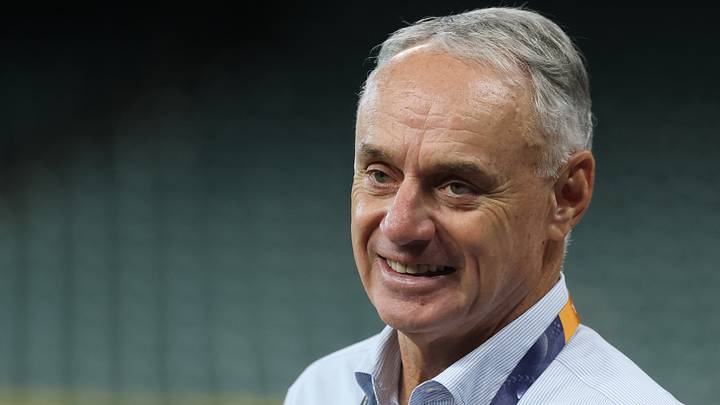
Welcome to the MLB postseason, where not even the thought of competing for a World Series title is enough to pack a stadium — and no, we don’t entirely blame Rob Manfred, NBC or any of the likely usual suspects, though there are certainly conversations worth having ahead of a potential lockout.
Rob Manfred and Major League Baseball must acknowledge their postseason schedule problem

Manfred’s detractors won’t want to hear this, but he inherited an unenviable playoff format — at least, from a broadcaster’s perspective — when he replaced Bud Selig in 2014. When Major League Baseball expanded to four playoff teams per league in 1994, that meant we’d see far more postseason games during the afternoon.
Which, if you know baseball history, wasn’t anything new. The World Series didn’t hold its first night game until 1971, and West Coast playoff games still often start around around 5 p.m. local time. All of that is fine, though, when the cameras show a capacity crowd.
But if the NL East-winning Braves don’t have anywhere near a full house when their game starts shortly after 2 p.m. ET, then there’s a problem. It was impossible to avoid the many empty seats behind home plate in both of Tuesday's matinees, and that’s not on the Braves or Astros or their fans. They can’t control the time of first pitch; only networks or the weather can.
And in fairness to Manfred, there isn’t an easy, realistic fix. Three or four postseason games were all played simultaneously in primetime as recently as the 1990s, and fans revolted against missing out on the action to such an extent that MLB felt compelled to change course for their next TV deal. If you want a postseason with more than four or six teams, well, this is the cost.

On one hand, you could experiment with putting multiple games on during two clear broadcast windows; for the sake of conversation, we’ll call it 5 p.m. and 8:30 p.m. ET. Balancing two games isn’t an issue for YouTube TV viewers who have the Multiview feature. We can’t say the same for anyone relying on their overpriced cable subscription.
Even that potential solution has its drawbacks. We’ve already seen streaming services, most notably Peacock and Prime Video, earn the exclusive rights to select MLB and NBA playoff games. Unless you have an emotional or financial investment in the White Sox-Astros series, why would you watch that over Braves-Phillies if both began at 5 p.m. ET?
Alternatively, the league and NBC could stick with the status quo, which is probably the safest solution. Is it fair to fans who want to actually attend the game? No, of course not. But the alternative is being a Rockies or Angels fan sitting at home and realizing they’re unlikely to have such an opportunity anytime soon.
Determining what times to start postseason games should be the least of Manfred’s problems during the next round of CBA talks, though that’s the fun of being a commissioner.
Did we say fun? We meant a plethora of other words.
 Add us as a preferred source on Google