
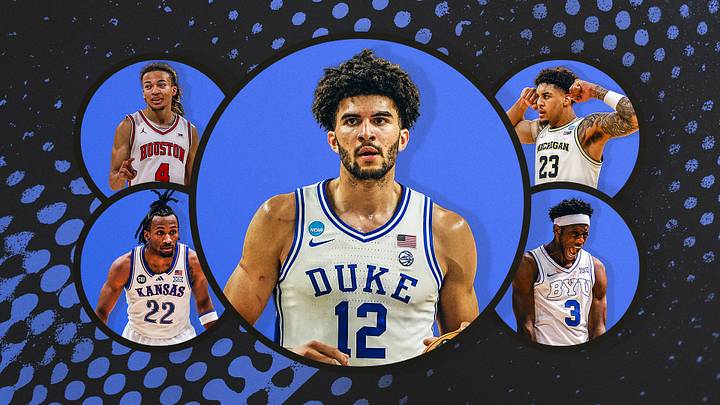
It's much too early to meaningfully critique the 2026 NBA Draft order. That said, the NBA offseason's order of operations can sometimes feel backward. The draft happens in June, followed by free agency and the eventual avalanche of blockbuster trades. Why are teams drafting rookies before their rosters are remotely settled? It's not hard to create an argument in favor of swapping those dates, and letting free agency determine how a team drafts, rather than vice versa.
For this exercise, the goal is not to say "I had Cameron Boozer No. 1 and thus he should be No. 1 in the re-draft." Instead, the goal is to take all the new data into account — free agent signings, trades and Summer League — and try to determine which teams would actually change their picks in hindsight, and why.
1. Washington Wizards: AJ Dybantsa

Original pick: AJ Dybantsa
Cameron Boozer was the most impressive teenager in Las Vegas — on top of being FanSided's No. 1 overall prospect — but the Wizards clearly preferred AJ Dybantsa on draft night. Summer League will not change that, especially since every move since then was coordinated around Dybantsa's fit and future (whether we agree with paying Trae Young $212 million or not).
Dybantsa was quite impressive in Summer League, to be fair. He's a walking paint touch with the size, burst and dexterity to create advantages on a whim. He still needs to become a more consistent shooter on the perimeter and create more for others, but he has All-NBA upside and the Wizards ought to be a fun watch.
2. Utah Jazz: Darryn Peterson

Original pick: Darryn Peterson
Darryn Peterson opened Summer League with a bang and ended with a bit of a whimper. Again, Boozer was No. 1 here at FanSided, but the Jazz thoroughly vetted and considered both before deciding that Peterson was their man — even with Boozer's father on staff, in the scouting department.
Boozer's strength and connective traits would've played nicely in the frontcourt now that Walker Kessler is gone, but the Jazz will still benefit plenty from Peterson's malleable on-ball, off-ball skill set. He's a flamethrower with better handles and passing chops than the Kansas tape might indicate, and he's a solid defender on the perimeter, which is especially valuable next to Keyonte George.
3. Memphis Grizzlies: Cameron Boozer

Original pick: Cameron Boozer
Cameron Boozer has done nothing but win at every level, so him leading Memphis to the Summer League title game was the least surprising development of all time. He will be the youngest player in the NBA next season, yet Boozer operates with the poise and command of a decade-long vet. He experimented with more mid-range and pull-up shooting in Vegas, which was really the only notch missing from his belt in college.
Boozer can hit 3s, attack closeouts, work DHOs and pass on the short roll, bully mismatches inside — all with supercomputer processing speeds, able to instantly detect and exploit lapses from his opponent. He's the most refined and well-rounded offensive forward to enter the league in quite some time, and Memphis would run up to the podium (again) to select him in a re-draft.
4. Chicago Bulls: Caleb Wilson

Original pick: Caleb Wilson
The top four stays the same, which should come as no surprise. This was a talented class with a clear-cut group of four at the top. Chicago was relegated to picking whomever fell into their lap, and with none of the top three picks providing reason for their original teams to panic, Caleb Wilson is once again their man.
Wilson lit up Summer League. He was probably the single most entertaining player to watch, uncorking step-back 3s and expanding his game well beyond the strict confines of his role at North Carolina. There are still questions about his offensive process and defensive fundamentals, but Wilson should quickly round into a dominant two-way force in the NBA given his athleticism, motor and burgeoning skill set.
5. Los Angeles Clippers: Brayden Burries

Original pick: Keaton Wagler
This is the first change-up, as Brayden Burries was by far the most impactful guard at Summer League. That only means so much, of course, but Burries played virtually mistake-free basketball while showcasing the ability to get downhill and create his own offense, in addition to his standard excellence on defense.
As somewhat of a Burries agnostic during the pre-draft cycle (he was No. 17 on FanSided's big board), this qualifies as a huge leap personally. But Burries was well-documented as a prospect of interest to the Clippers, and he's a far more seamless fit next to Darius Garland in the L.A. backcourt due to his rugged physicality on both ends.
6. Brooklyn Nets: Mikel Brown Jr.

Original pick: Mikel Brown Jr.
Mikel Brown Jr. mostly delivered on the hype in Vegas, dropping extremely flashy dimes and hitting deep 3s to get a morose Nets fanbase riled up again. He will experience all the standard ebbs and flows of a rookie point guard in the NBA, but Brooklyn has quietly put a solid support system around him. Jordi Fernandez is a great coach, while Julius Randle and second-year guard Egor Dëmin — one of the best players in Vegas this summer — can allow Brown to play off the ball some, easing his burden.
Brown needs to add muscle, work to limit turnovers and prove that he can defend in an NBA ecosystem, but in terms of pure skill and basketball intuition, he's probably the highest-upside guard in the draft not named Darryn Peterson.
7. Sacramento Kings: Kingston Flemings

Original pick: Darius Acuff Jr.
In all likelihood, the Kings are bullish on Darius Acuff Jr., who has known GM Scott Perry since childhood. Sacrmanto loudly broadcast its interest in Acuff for months and quickly snapped him off the board when he fell to No. 7. That said, Acuff's Summer League journey was not the smoothest. He looked lost on defense, as he so often did at Arkansas, and he strongly to score efficiently against higher-level defenders.
Kingston Flemings, on the other hand, was the most impressive facilitator in Vegas, putting pressure on the rim and distributing with remarkable poise and precision given the inherent chaos of a Summer League environment. He's also a stellar defender and a tremendous locker room presence; his winning personality was quickly evident to Hawks fans. It's easy to worry about Acuff going to a team with such more infrastructure. Flemings, frankly, may be better equipped to weather the storm and help those around him.
8. Atlanta Hawks: Keaton Wagler

Original pick: Kingston Flemings
With Flemings off the board, Atlanta probably considers Acuff here, or Aday Mara — another popular pre-draft candidate floating in the Hawks rumor mill. But Keaton Wagler went No. 5 for a reason, as he clearly garnered substantial interest from NBA front offices after his magical freshman season at Illinois. Wagler fits the Hawks stylistically as a moldable on- or off-ball operator, with strong poise as a decision-maker and an elite 3-point shot.
The Hawks should have no trouble envisioning Wagler running the floor and spacing out to the 3-point line, attacking closeouts and making sharp decisions, as the offense flows through Jalen Johnson. Moreover, the concerns around Wagler's physicality, which reached a fever pitch during his inconsistent Summer League run, would be better masked in Atlanta with Lu Dort, Dyson Daniels and Nickeil Alexander-Walker to absorb the tougher defensive assignments on the perimeter.
9. Dallas Mavericks: Yaxel Lendeborg

Original pick: Morez Johnson Jr.
No slight to Morez Johnson Jr., who was quite impressive in his own right in Vegas, but Dallas might reconsider his former Michigan teammate in this spot. Yaxel Lendeborg led Golden State to the Summer League title and took home MVP. Plenty of Summer League MVPs come and go without great careers, and Lendeborg's age — he'll turn 24 next month — puts him on a different timeline than your standard lottery pick. Still, he was so clearly a level above the competition, not unlike this past season at Michigan.
Lendeborg checks so many boxes that Masai Ujiri loves, which are the same boxes that Johnson checked. Lendeborg offers positional size and versatility, but he's a better shooter at higher volume than Johnson, with real utility as a ball-handler and connective playmaker. Lendeborg's robust two-way skill set could pair nicely with Cooper Flagg in the Mavericks frontcourt for a long, long time.
10. Milwaukee Bucks: Darius Acuff Jr.

Original pick: Brayden Burries
Milwaukee could take this pick in several directions, but Darius Acuff Jr.'s name carries too much weight to slide past No. 10. The Bucks are overindexed on guards after the Giannis trade, but with such a long rebuild ahead, that shouldn't really impact their decision-making. If anything, slow-playing Acuff's development a bit — and not throwing him directly into the deep end, a la Sacramento — might end up being a net positive.
Acuff was so, so good at Arkansas, displaying a level of precision and control that helped scouts look past the horrific defensive tape. He will probably never defend at a high level in the NBA, but he could develop into a legitimate franchise point guard, elite out of the pick-and-roll and equipped with a deadeye pull-up jumper.
11. Golden State Warriors: Morez Johnson Jr.

Original pick: Yaxel Lendeborg
Dallas and Golden State effectively swap Michigan forwards, with the Dubs selecting Morez Johnson Jr. in lieu of Summer League MVP Yaxel Lendeborg. Johnson is almost four years younger but he serves a similar end goal. The Warriors want someone to help them compete in Stephen Curry's twilight years. Johnson has the rugged physicality and defensive IQ necessary to make an immediate impact on that end of the floor, especially with Draymond Green there to mentor him. Plus: Golden State no longer needs to worry about Lendeborg spinning unfiltered thoughts to the media (not that it isn't endearing).
Johnson is less robust in his offensive repertoire, but Dallas cut him loose in Summer League and let Johnson explore the outer limits of his skill set, with excellent results. He's extremely efficient around the rim and he should develop into a bankable spot-up shooter in time. Given his switchy, five-position defensive profile, Johnson should quickly find a niche in Steve Kerr's rotation.
12. Oklahoma City Thunder: Bennett Stirtz

Original pick: Aday Mara
With Isaiah Hartenstein and Chet Holmgren both locked up for a while, plus Jaylin Williams as an above-average backup in his own right, it'd be fascinating to see if OKC doubles down on the Aday Mara pick. It was one of my favorite selections in the moment and it's far too early to abandon ship just because he looked gassed in Summer League.
That said, the Thunder's offseason mostly consisted of shedding marginal salaries (Isaiah Joe, Aaron Wiggins, Lu Dort) to dance around the second apron. The goal, of course, is for OKC's endless supply of draft picks to backfill a deep roster with cheap, controllable talent. As Cason Wallace gears up for a full-time starting gig, there's more room for Bennett Stirtz — the Thunder's pick at No. 16 — to break through. His unrivaled IQ and poise as a lead ball-handler could mean he's more immediately impactful than Mara, who projects more as a situational big out of the gate.
13. Milwaukee Bucks: Nate Ament

Original pick: Nate Ament
Realistically, the Bucks telegraphed their interest in Nate Ament for weeks and were gleeful when he fell into their laps at No. 13. Ament is not a prospect I've vouched for much — at least not in a lottery context — and he was hit or miss at Summer League, but it's easy enough to understand the Bucks' motivation here.
Ament is a legitimate 6-foot-10 wing with dribble-pass-shoot upside. He needs to improve across the board and will require a patient hand, but Milwaukee is the most overt rebuild in the NBA. Especially after stockpiling guards with the Giannis trade (and their selection of Acuff at No. 10 in their re-draft), finding a big wing who can play off-ball and fill gaps as a spot-up scorer is logical. Methinks the Bucks take Ament again and bank on his unique upside, hoping he can add muscle and become more effective scoring around the rim.
14. Charlotte Hornets: Aday Mara

Original pick: Hannes Steinbach
While Mara looked a step slow and frequently out of breath in Summer League, it's hard to judge his impact in such a chaotic environment. Actual NBA offenses (and defenses) and more structured, which should allow Mara to shine — probably in shorter bursts, to start — as a premier shot-blocker, rim-finisher and connective passer.
Mara needs to get more physical and ramp up his stamina, but he was the most impactful interior defender in college basketball last season. The Hornets are clearly changing their DNA after the LaMelo Ball trade. Between Mara, Moussa Diabaté and Ryan Kalkbrenner, Charlotte would have a trio of bigs who can anchor the paint and elevate a feisty Hornets defense. Mara's ability to sling outlet passes and work two-man actions with Kon Knueppel or Brandon Miller in the halfcourt should also pay dividends sooner than later. He's too smart and skilled at 7-foot-3 to drop further than this.
15. Chicago Bulls: Hannes Steinbach

Original pick: Dailyn Swain
The center position remains a point of weakness for Chicago, even after the Nic Claxton trade. Hannes Steinbach was arguably the best rebounder in college hoops as a freshman. New Bulls GM Bryson Graham has preached a SLAP (Size, Length, Athleticism, Physicality) philosophy. Steinbach checks several boxes and can help a team win on the margins with sheer effort and brute force. He's a more skilled finisher than he gets credit for, too, while original pick Dailyn Swain was mostly unwatchable in Summer League.
16. Oklahoma City Thunder: Allen Graves

Original pick: Bennett Stirtz
After selecting Bennett Stirtz four spots sooner, OKC pivots to another very Thunder-coded prospect in Allen Graves. The Santa Clara forward put up monster stock numbers as a freshman, emerging as a top-20 pick despite coming off the bench for a mid-major program. Graves gets his hands everywhere on defense and he's a 40 percent 3-point shooter, with untapped upside as a passer and connector, which he flashed pretty regularly during Toronto's Summer League stint. OKC needs to add more size and defense in lieu of Lu Dort.
17. Detroit Pistons: Ebuka Okorie

Original pick: Ebuka Okorie
Detroit won't mess up a good thing, as the Ebuka Okorie pick felt inspired at the time and still is. The Pistons desperately need more shot creation around Cade Cunningham. Okorie was one of the most prolific slashers and iso scorers in college basketball as a freshman. He's an undersized guard with middling assist numbers, but truly it's rare to find prospects who blend scoring volume and efficiency as well as Okorie. He's small, but he's also a bullish defender who shouldn't compromise Detroit too much on that end.
18. Charlotte Hornets: Labaron Philon Jr.

Original pick: Christian Anderson Jr.
Charlotte's decision to take a point guard was curious on draft night, but that narrative flipped as soon as the LaMelo Ball trade became official. Summer League was not kind to Christian Anderson Jr., however. He's so reliant on 3s to score and his slight frame buckled against his first taste of NBA competition. What if Charlotte goes a different route with Labaron Philon Jr., who's a far more dynamic, well-rounded scorer despite his own lack of strength. Philon's ability to shift gears, create advantages and finish with touch in the intermediate range could have him occupying a major role for Charlotte out of the gate.
19. Toronto Raptors: Cameron Carr

Original pick: Allen Graves
Cameron Carr garnered legitimate lottery buzz pre-draft, so his slide to the Lakers at No. 24 caught folks off guard. It felt straight-up silly at Summer League, where Carr's deep shooting range and live-wire athleticism consistently popped. Toronto needs more shooting around Kawhi Leonard and Scottie Barnes. Carr can get out and run, fire with confidence off the catch and add to Toronto's elite defensive infrastructure with his rangy off-ball presence.
20. San Antonio Spurs: Jayden Quaintance

Original pick: Jayden Quaintance
There's a good chance Jayden Quaintance redshirts his rookie season, which the Spurs knew ahead of time. Despite multiple knee injuries, which essentially robbed him of his sophomore year at Kentucky, Quaintance is still the second-youngest player in the NBA — a week older than No. 3 pick Cameron Boozer. He's a phenomenal defender, with sonar-like instincts protecting the rim and the athleticism to switch out on the perimeter and bottle up guards like it's second nature. The defensive upside of a Quaintance-Wembanyama frontcourt down the road remains as tantalizing as ever.
21. Memphis Grizzlies: Karim López

Original pick: Karim López
Memphis later dealt away Santi Aldama, so there's more of a pathway to minutes for Karim López than initially existed on draft night. The Jerami Grant and Isaiah Stewart trades did not ease their frontcourt logjam, but alas — there's no reason for Memphis to second-guess this pick. López is coming off of a productive pro season in Australia, where his slashing, rebounding and improved defense clearly caught the attention of a smart Memphis front office.
22. Philadelphia 76ers: Zuby Ejiofor

Original pick: Labaron Philon Jr.
The Sixers went Best Player Available with Labaron Philon on draft night, but after adding two high-usage stars in Jaylen Brown and LeBron James, plus signing another slight-of-build backup guard in Anfernee Simons, one has to imagine Philadelphia would use his absence in this re-draft to target their greatest area of need: frontcourt depth. It's hard to feel great about either Adem Bona or Ariel Hukporti starting in the non-Embiid games. Zuby Ejiofor is a bundle of muscle and energy, with the potential to play the four or five as needed.
23. Atlanta Hawks: Tarris Reed Jr.

Original pick: Zuby Ejiofor
Atlanta still address the center position with Zuby Ejiofor off the board. Tarris Reed Jr. was the best player for the March Madness runners-up at UConn. He's an elite rebounder and a skilled, balletic interior scorer, with solid metrics as a rim protector, even if there are some lapses in judgement to clean up. The Hawks need more brute force behind Onyeka Okongwu at the five. Reed has the frame, skill and IQ to contribute right away on a contending team.
24. Los Angeles Lakers: Ryan Conwell

Original pick: Cameron Carr
Miami made Ryan Conwell the 37th overall pick, but at Summer League he felt like one of the most obvious day-one contributors in his class. The Heat have a particular need for 3-point shooting, which Conwell can supply at massive volume. He's also an excellent defender, despite his undersized frame. The Lakers need more size in general, but Conwell's sticky point-of-attack defense and prolific movement shooting would probably help him earn a role under J.J. Redick, especially with Luka Dončić there to set the table.
25. Dallas Mavericks: Meleek Thomas

Original pick: Sergio de Larrea
Mavs fans are probably content with Sergio de Larrea, who can pass the hell out of the basketball at 6-foot-6. But there are real questions as to his ability to score and defend, which creates challenges on this Mavs roster. Meleek Thomas, meanwhile, fell to the second round in completely unexpected fashion before lighting up Summer League. He's a talented off-ball scorer with more juice as a self-creator than he got credit for playing next to Darius Acuff at Arkansas.
26. San Antonio Spurs: Alex Karaban

Original pick: Tarris Reed Jr.
When the Kings originally picked Alex Karaban at No. 29, it felt too rich, in part because it's Sacramento. But Karaban built a winning track record at UConn, lauded for both his leadership qualities and his adaptability. He also fits a much more glaring need in San Antonio, offering size and shooting at the four spot behind newcomer Tobias Harris. Karaban would be a plug-and-play contributor for the Spurs, who can cover for him on defense better than most teams.
27. Boston Celtics: Dailyn Swain

Original pick: Chris Cenac Jr.
Dailyn Swain looked lost at Summer League. The Bulls asked him to play point guard and he was ill-prepared. Still, Swain was a top-10 prospect at FanSided and there's a reason the Bulls picked him earlier than expected at No. 15. The Celtics take advantage in the re-draft, adding some much-needed perimeter defense — while hoping Swain can figure out his role on offense as a prolific slasher and playmaker on the wing. He can apply rim pressure, an element Boston desperately lacks in lieu of Jaylen Brown.
28. Brooklyn Nets: Joshua Jefferson

Original pick: Joshua Jefferson
The Nets nailed their pre- and post-draft dealings, using the Julius Randle salary dump to acquire an extra first-round pick, then taking Randle's eventual replacement. Joshua Jefferson fits Brooklyn's M.O. as a prospect with outlier IQ and passing chops for his size and his position. Jefferson is not the flashiest athlete, but he can operate as a real hub on offense and he's a smart, active team defender. Don't be shocked if he's running many of the same plays that Randle does with the second unit.
29. Sacramento Kings: Chris Cenac Jr.

Original pick: Alex Karaban
Look, Chris Cenac Jr. was not "my guy" pre-draft, but it's easy enough to understand the appeal. He's a monster athlete; he's a true 7-footer who can shoot, catch lobs and hammer the glass on both ends. Cenac needs to be more thoughtful with his shot selection and more engaged on defense, but he has a strong work ethic by all accounts and he could benefit from NBA infrastructure. The Kings are probably the worst possible landing spot, but then again, Sacramento can let Cenac work through it. Reuniting with Houston teammate Kingston Flemings wouldn't hurt either. The Kings get built-in chemistry between their franchise point guard and their potential Domantas Sabonis successor.
30. Phoenix Suns: Bruce Thornton

Original pick: Koa Peat
The Suns clearly zeroed in on Koa Peat, the Arizona product, for reasons beyond basketball. The front office is also littered with Michigan State alumni, which keeps being more relevant than it should. So Ohio State, really? For purely basketball reasons, let's say yes. The Suns could use a proper point guard and Thornton was mighty impressive at Summer League. He's small, but he's built like a running back with unbelieveable strength and ball-handling craft. The Miles Bridges trade diminishes the need for another one-dimensional power forward anyhow.
 Add us as a preferred source on Google