
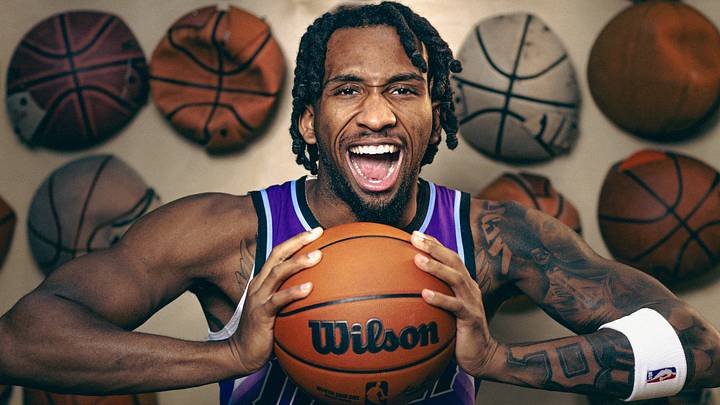
Darryn Peterson landed at No. 22 on FanSided's 25-under-25 NBA Player Rankings this season, ranking the best young players in the NBA. Check out the rest of the list here.
Despite plenty of smokescreens and deception, the Utah Jazz went with consensus and selected Kansas guard Darryn Peterson with the No. 2 overall pick in the 2026 NBA Draft. And was there ever any doubt, really? The Ainges love a talented scoring guard and Peterson might be the most versatile and dynamic scoring guard since Markelle Fultz, back when he could still shoot.
Peterson comes with his share of downside. Mysterious cramping issues heavily limited him in his one year at Kansas. He was also an extremely low-volume playmaker for a so-called point guard, playing more like an off-ball wing. Some of that is situational — the Jayhawks' offensive setup benefitted nobody — but Peterson did not get to show as much at the college level as his peers near the top of draft boards. Once the top recruit in his high school class, however, Peterson's talent is beyond reproach. He ought to showcase it sooner than later on a sneaky good Jazz team.
For more player rankings and deep analysis for every NBA team, subscribe to The Whiteboard — FanSided's NBA email newsletter.
Darryn Peterson steps into a featured role on a postseason hopeful in Utah

Peterson jumped right into the staring lineup next to Keyonte George. It's a fascinating, quite unique setup for such a high draft pick. The Jazz are built like a contender, with two max contract stars in Jaren Jackson Jr. and Lauri Markkanen, plus another high-voltage guard in George, who just inked a massive long-term extension of his own.
Despite a disastrous 3-13 start, things haven't really changed for the Jazz. There's nothing to tank for and no realistic incentive to reset. This is the roster and it's pedal to the metal for the playoffs.
This is a clear turning point for the Jazz franchise. Utah has very patiently engineered its rebuild over the last half-decade, but now with Jackson and Markknane entrenched, and with Peterson as their big lottery prize, the roster is damn near set. Utah has a ton of young, cost-controlled depth. The core (minus JJJ) has spent ample time together. The Jazz are probably mirroring OKC's team-building strategy under Sam Presti as well as any team can, even if the roster is not quite on that level.
It leaves Peterson caught between timelines a bit. He's a rookie, so there will be a natural adjustment period. Utah will also want to feed him touches and let him explore the breadth of his skill set; and yet, Utah also wants to play a cohesive, competitive brand of basketball, with multiple established 20-point scorers on the roster. The primary challenge of Peterson's rookie year will be finding the right balance between aggression and blending in — when to hunt shots and when to take more of a backseat.
So far, he's done that — averaging 16.5 points and 3.6 assists per game but deferring often to George and Markkanen.
Expect more from Darryn Peterson than the college tape shows

It was uniquely challenging to get a pulse on Peterson's brief Kansas stint. Beyond the injuries and the mystery-shrouded comments, both from him and from coaches, Peterson just never quite looked himself. And yet, he was also extremely impactful for a freshman, despite a poor team context and despite the clear lack of burst and dexterity.
Peterson's high school tape shows him frequently attacking the lane, pressuring the rim and creating advantages with twitch and craft. At Kansas, he almost never got a step on his defender. He settled for contested mid-range jumpers and functioned as more of a movement shooter, firing off the catch without much bag work to speak of. It worked. He's a knockdown shooter, full stop. His versatility — the ability to scale up or down, to play with and without the ball — is part of the appeal. But Peterson is not the No. 2 pick unless Utah believes he can achieve something closer to his high school, creating for both himself and for teammates.
All signs point to Peterson entering his rookie season at full strength. It seems he has diagnosed the cramping problem and fixed it. If he's operating at full capacity, the Peterson taking the floor in Salt Lake City will look night-and-day different than the Peterson we saw off and on in Lawrence last season. He will provide Utah some much-needed juice as a halfcourt creator. The Jazz have shooting at every position, something Kansas very much did not. That should open up driving lanes for Peterson to exploit. Perhaps that leads to a greater playmaking footprint, too. Peterson has never been a bad passer. He sees the floor and reacts well under pressure. It's all about putting him in a better position to utilize that aspect of his game.
Rookie seasons are an inherently mixed bag, but Peterson has probably the deepest team around him of any top-10 pick. The Jazz also run an incredibly fluid, up-tempo offense under Will Hardy, predicted on sharp, decisive ball movement. It's a great environment to come up in. Do not be shocked if, despite all the bumps in the road last season, Peterson is the most consistently productive and impactful rookie. He has a chance to help Utah reach new competitive heights
 Add us as a preferred source on Google