
Key Points
Bullet point summary by AI
- Major tournaments sometimes push back kickoff times due to dangerous weather conditions.
- Stadium safety protocols focus on one specific atmospheric threat that forces immediate pauses.
- The rules create a clear timeline for when play can resume, balancing fan expectations with participant safety.
For the most part, soccer operates much like American football does in the States — it's not a sport that shies away from being played in the elements. In fact, it relishes the opportunity, with some of the beautiful game's most iconic moments coming in less-than-ideal conditions.
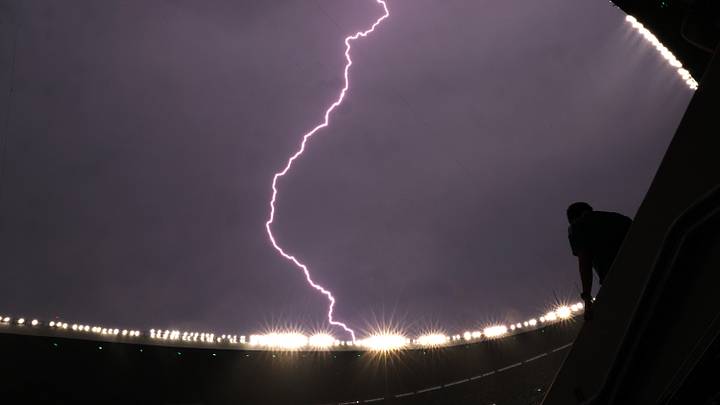
But that doesn't mean that the World Cup is completely immune from Mother Nature's influence. Fans learned that the hard way on Sunday, when the much-anticipated matchup between Mexico and England at Estadio Azteca had its scheduled start time pushed back a full hour by FIFA due to inclement weather in the Mexico City area.
Just how does FIFA decide when a delay goes into effect, and for how long? Here's everything to know about weather rules at the World Cup.
How FIFA decides when to delay games at the World Cup

Soccer has no problem being played in the rain; much like American football, you're expected to play through the mud no matter how wet things get. There's a reason why "can you do it on a rainy night in Leeds?" has become shorthand among English soccer fans for defying the elements.
Lightning, though, is a no-go. For the 2026 World Cup, FIFA is following the guidance set forth by the National Oceanic and Atmospheric Administration (NOAA), which advises that the detection of lightning within an eight-mile radius of a given stadium should result in a minimum delay of 30 minutes. That 30-minute clock resets after every subsequent lightning strike.
Once a full half-hour elapses without any lightning, the players are given 15 minutes to warm up after returning to the field. Such was the case in Mexico City on Sunday night, as thunderstorms blew through the area just before the scheduled kickoff time of 8 p.m. ET (7 p.m. local time).
That's the lone weather-related exception FIFA makes (barring something truly out of the ordinary), and it's not hard to understand why. Stadiums are obviously vulnerable to lightning strikes, especially those at extreme elevation like Azteca — which sits more than 7,000 feet above sea level, making it one of the most imposing fortresses in world sport. Everyone is anxious for the game to get underway, but no match is worth putting players, coaches and fans at risk by allowing them to be out in the open when lightning is in the area.
This isn't the first time that weather has delayed things at this World Cup, either. The second half of the France-Iraq match during group play got off to a late start due to lightning near Lincoln Financial Field in Philadelphia
 Add us as a preferred source on Google