
Key Points
Bullet point summary by AI
- The current World Cup in North America has seen record-breaking attendance and widespread acclaim from all sides.
- FIFA's rotation rules and infrastructure requirements make only one region viable for the 2038 tournament.
- The next decade promises a packed schedule of major soccer events in the same host country, setting the stage for a historic repeat.
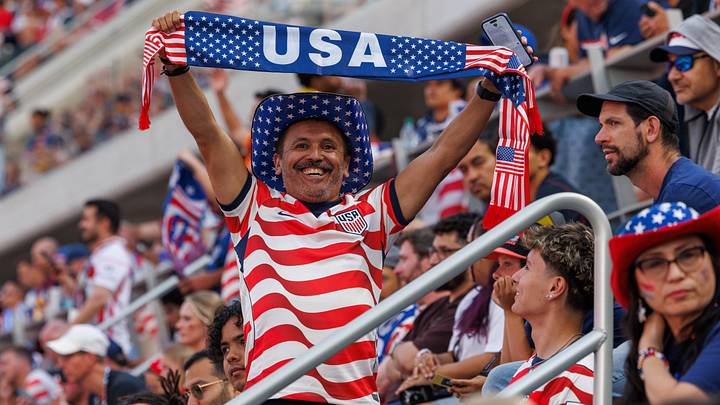
As we approach the end of the group stages, the World Cup in the United States has been a roaring success so far. Over four million spectators have attended matches, an average of over 63,000 per game, on course to surpass the previous per-game average record of 68,991, set during USA '94.
So, having the World Cup in America appears popular with FIFA, spectators and other key stakeholders. Thus, could the biggest show on earth be returning stateside sooner than most would imagine? Well, Andrew Giuliani, who is currently executive director of the White House Task Force overseeing the World Cup, certainly believes the U.S. could host again soon, saying this:
"When you think that this World Cup may at some point expand out to 64 teams, I think the United States can handle it... there's no better country that's positioned to host a World Cup than the United States, and I think we're seeing that on social media... the US truly is extremely welcoming."
Giuliani also noted that the U.S. has "such an incredible infrastructure" particularly when it comes to stadia, making it one of the few countries on earth equipped to stage a 48 or even 64 team World Cup. He also strongly suggested that the States will bid for the 2038 edition, so why does it feel like a foregone conclusion that this will happen?
Future FIFA World Cup hosts
- 2030: Spain, Morocco & Portugal + centenary hosts: Argentina, Uruguay and Paraguay.
- 2034: Saudi Arabia.
In four summers' time, the vast majority of the World Cup will be played in Spain, Portugal and Morocco. However, to commemorate the first-ever World Cup in Montevideo 100 years ago, Uruguay as well as Argentina and Paraguay will also host one opening group stage match each. This may seem like an unnecessary token gesture from FIFA, but was very much a calculated one.
As per FIFA's two-cycle rotation rule, if a continent has hosted a World Cup, they cannot host the next two. Thus, for 2034, CONCACAF, UEFA, CAF and CONMEBOL were all taken off the table, leaving only Asia and Oceania, helping Saudi Arabia bid unopposed, confirmed as hosts in eight years' time.
Thus, looking at 2038, the current rules prohibit the World Cup from being held in Asia, Africa, Europe or South America. This would only leave North America and Oceania, FIFA's smallest confederation. Thus, unless New Zealand are planning a bid, it seems inevitable that the World Cup will be back in the U.S. in 12 summers' time. This would continue a busy period of summer soccer tournaments being staged in the United States, a trend that is showing little sign of slowing down.
Summer soccer tournaments potentially staged in USA

- 2024: Copa América
- 2025: FIFA Club World Cup
- 2026: FIFA World Cup
- 2028: Copa América (currently in discussions with CONMEBOL to host)
- 2028: Summer Olympic Games in Los Angeles
- 2029: FIFA Club World Cup (currently a candidate to host)
- 2031: FIFA Women's World Cup
- 2038: FIFA World Cup (current favorites to host)
While the United States and North America aren't yet confirmed for three potentially major tournaments (2028 Copa América, 2029 FIFA Club World Cup and 2038 FIFA World Cup), they are still among the favorites or at least candidates to host. That shows the rousing success that has been the 2026 event with the sporting infrastructure available to them, and why it could mean more to come in terms of major tournaments.
 Add us as a preferred source on Google