
Key Points
Bullet point summary by AI
- The Oklahoma City Thunder face pivotal draft decisions after a tough playoff exit to San Antonio. With two first-round picks, they have plenty of options.
- Sam Presti's history of draft success makes this year critical for long-term contention in the Wembanyama era.
- Three realistic pick combinations could address defensive gaps and add immediate impact players at key positions.
The Oklahoma City Thunder approach the 2026 NBA Draft with new questions about the future of the organization after a sobering Game 7 loss to San Antonio in the Western Conference Finals. This is still a deep team, led by a two-time reigning MVP and equipped with an all-time great defense. But is OKC built, truly, to conquer the Wembanyama era? This draft could go a long way toward determining the answer.
Sam Presti, Vince Rozman and Oklahoma City's front office tend to thrive in the draft. It's part of what has made the Thunder's excellence so sustainable. While there's a decent chance that OKC either trades up or trades out of at least one of these picks, the Thunder can also feel good about staying put and adding two instant contributors. Here are the best (realistic) outcomes:
Kingston Flemings (No. 12) and Jayden Quaintance (No. 17)

This happens to align with FanSided's most recent mock draft.
For the majority of this draft cycle, Kingston Flemings felt like a lock to land much higher than No. 12. After some finishing regression late in the season, however, Flemings' substandard measurements at the Combine — 6-foot-2.5 barefoot with a 6-foot-3.5 wingspan — sent his projection spiraling. He will still interview well and thrive in a workout setting, but Flemings falling into OKC's lap is no longer unimaginable.
Oklahoma City does not "need" another guard, but this is how Sam Presti operates. He drafts according to team philosophy and schematic fit more than anything else. Flemings is an explosive downhill attacker, with the best first step in the draft. He creates and extends advantages with advanced feel, able to hit the brakes, probe the middle of the floor and sharply distribute to teammates.
Flemings is also an incredible defender, height be damned. He's a pogo-stick leaper who times every movement to perfection. His instincts for disruption are top notch and he will find a way to make an impact on that end.
As OKC cycles players in and out to manage their cap situation in the years ahead, Flemings' opportunity to shine could come sooner than later, even in the league's deepest backcourt.
As for Jayden Quaintance, again, this feels like a classic Sam Presti pick. The Thunder don't typically target older, more established players. Youth, tools and schematic alignment are key. Quaintance, despite being a sophomore, is 18 years old — a week older than Cameron Boozer, the youngest prospect in the draft. Injuries have ravaged his two years in college, but when healthy, Quaintance is the sort of switchable, physically gifted defender who could come in reeeeeal handy against, say, the San Antonio Spurs come May.
Quaintance switches comfortably across the positional spectrum and gets off the floor easily as a rim protector, with a special nose for the basketball relative to his age. OKC needs to decide on Isaiah Hartenstein's future coming up, and confidence in Chet Holmgren is waning at the moment. Quaintance could emerge as a huge value add sooner than later, assuming the medicals check out.
Yaxel Lendeborg (No. 12) and Morez Johnson Jr. (No. 17)

This would require a bit of good fortunate for Oklahoma City, as Yaxel Lendeborg and Morez Johnson Jr. are both hot names at the moment. There's a decent chance both are off the board well before the 17th pick — maybe even before the 12th pick.
So little is guaranteed in the draft, however, and if the board falls favorably enough, OKC could add a pair of championship teammates. Lendeborg will turn 24 as a rookie, which puts him on a different timeline than most Thunder picks. But he's such a strong match, culturally and basketball-wise, that it's hard not to envision Lendeborg in OKC blue. It helps that the Thunder probably feel more urgency than ever after that Spurs series.
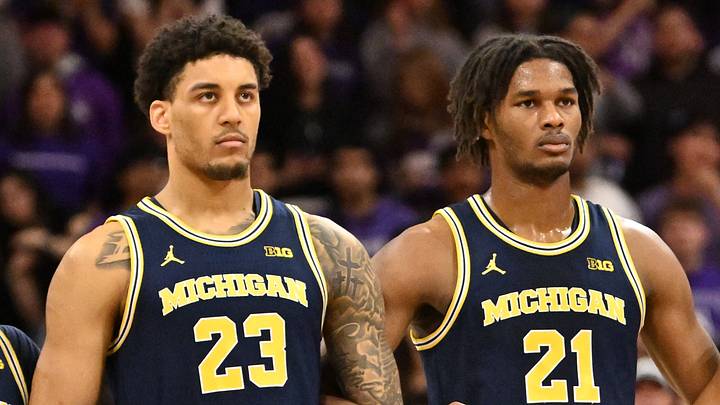
Lendeborg and Johnson (a 20-year-old sophomore) are both 6-foot-9, 250ish pound forwards with extremely complementary skill sets. Lendeborg was the lifeblood of Michigan on both ends — a much-improved shooter and finisher with the strength to punish mismatches and the finesse to attack closeouts. Johnson is more of a rim-runner and spot-up shooter.
Both provide a level of physicality that OKC is missing at the forward positions. In Johnson's case, he's more than capable of anchoring the defense as a small-ball five, which could come in especially handy if Isaiah Hartenstein walks.
Johnson is a monster rim protector, with a 7-foot-4 wingspan and impeccable timing from the help-side. Lendeborg is more of a switchy forward type — not necessarily quick enough to contain guards, but certainly able to handle tough assignments on the wing or sink down to the low post and help out there, too.
Straight up, OKC would be adding two of the best defenders in the draft at what is arguably their weakest position. Teammates who know each other and have recent, high-level winning experience. It's hard not to be confident in how that arrangement plays out.
Aday Mara (No. 12) and Allen Graves (No. 17)

Aday Mara is another Michigan standout who could rise beyond OKC's grasp (with possibility for a trade-up notwithstanding), but it will depend on how teams in front of the Thunder value a standard low post anchor in constrast to an unusually deep guard class.
Should Mara fall to OKC, he's a really seamless fit on paper, especially when accounting for Hartenstein's murky future. Mara can replace some of the value Hartenstein provides as a screener and a connector in the middle of the floor. At 7-foot-3, Mara maps out the court from a high vantage point and whips challenging passes every which direction. His feel and vision at the five spot is unique and quite complementary to how the Thunder play basketball.
Mara will need to play more forcefully to avoid sloppy turnovers or a high foul rate, which held him back on occasion at Michigan. But he was the single most dominant rim protector in college hoops this past season and defensively alone, his presence should amplify a lot of what OKC does well. He can empower rangy, aggressive perimeter defenders like Cason Wallace and Alex Caruso.
Allen Graves is a more classic Sam Presti pick — a freshman forward with hints of dribble-pass-shoot utility (special emphasis on shoot) who obliterating stat models on the defensive end, despite limited minutes at Santa Clara. Graves blows up passing lanes on the regular and is a very actice help-side rim protector.
There isn't a single "answer" or "stopper" when it comes to defending Victor Wembanyama, but OKC loading up on size and defensive activity certainly is not a bad strategy. Graves' touch and feel projects well toward offensive growth and OKC has the depth to take things as patiently as needed.
This combination essentially lands two of the best defensive prospects in the class in OKC — a theme throughout all of these hypothetical packages.
More NBA news and analysis:
 Add us as a preferred source on Google