
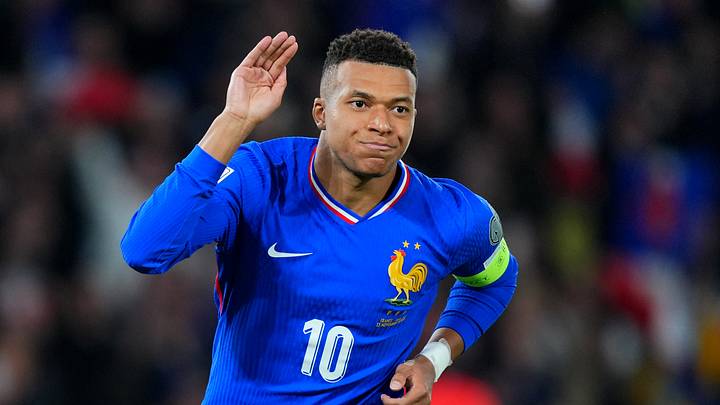
Kylian Mbappé's career has been defined by World Cups. He announced himself to the world in 2018, helping France lift the trophy and becoming only the second teenager, after Pelé in 1958, to find the net in a World Cup Final. He claimed the Golden Boot in 2022, and with his hat trick against Argentina in Qatar, he cemented his place among the tournament's all-time greats.
But this summer feels different. After two turbulent, trophyless seasons at Real Madrid, he has entered a different phase of his career, under greater pressure than ever before to deliver. With questions surrounding his leadership and France's balance, Tuesday's opener against Senegal could tell us a lot about how this summer will unfold (and where he ends up as an all-time leading World Cup goalscorer).
Mbappé's first World Cup as France captain
Following Hugo Lloris' international retirement after the last World Cup, French manager Didier Deschamps made a controversial call when selecting his new captain. It was widely expected that he would give the armband to Antoine Griezmann, considering his exemplary professionalism, as well as the fact that he featured in 84 consecutive internationals between 2017 and 2024. However, Deschamps instead went with Mbappé, a decision that upset Griezmann to such an extent that he retired out of the blue soon after.
So why is this noteworthy? It's very common, particularly at the international level, for the most famous or best player to be made captain. But Mbappé is continually criticized for negatively affecting dressing room morale and harmony, making him an odd fit for a leadership role. Even after three and a half years as skipper, featuring a run to the Euros semis, it still feels somewhat awkward.
Tactically, as Real Madrid has discovered, and Paris Saint-Germain before that, it is difficult to build a cohesive team featuring Mbappé. His inability, or unwillingness, to press leaves his side effectively a man short out of possession and, against elite opposition, it is almost impossible to carry a passenger. So, would France actually be better off without their superstar?
Ousmane Dembélé's rise has changed the conversation
A key reason the conversation around Mbappé has shifted is the rise of his former PSG teammate and close personal friend Ousmane Dembélé, who has been the star of les Parisiens' back-to-back Champions League triumphs, scoring 55 club goals across the past two seasons, of which 16 have come in UEFA's premier competition. He was awarded the Ballon d'Or at Théâtre du Châtelet in Paris last September, a prize that has alluded Mbappé so far.
For France though, Dembélé has never really shown his best, scoring just seven goals in 59 caps. His only two goals for les Bleus since November 2023 have come against Belgium and Croatia, scoring from a central position in the latter. So the question of whether he should be used there more permanently certainly exists. Many onlookers are calling for Deschamps to simply recreate the frightening PSG forward line featuring Désiré Doué and Bradley Barcola, with Michael Olise added in. Mbappé's presence means that his won't happen though, so while he may score goals this summer, it's possible he's having a negative impact on the supporting cast.
Senegal is exactly the kind of opponent that will expose any weakness
Even though the 48-team format is forgiving, France cannot afford a slow start at this World Cup. That's because they've landed in something of a group of death, still to face Norway in Foxborough in 10 days.
Twenty-four years ago, the Senegal beat France 1-0 in Seoul, with the reigning world and European champions eliminated in the group phase without so much as scoring a single goal thereafter.
Well, Pape Thiaw's team will believe they can repeat that result. Senegal was a team of debutant minnows back then, but they are a genuine force to be a feared these days. Their team has reached three of the last four Africa Cup of Nations Finals, hoisting the trophy aloft twice. This will be its third consecutive World Cup. In total, Senegal has lost just three of its last 45 internationals, enjoying friendly wins over Brazil in Lisbon and England in Nottingham during this period.
Given the historical ties between the two nations, both on and off the football pitch, Senegal's players will be ultra-motivated to win in New Jersey. Thus, France can ill-afford to carry Mbappé as an off-ball passenger. If France does have any weaknesses, you can bet they'll be exposed.
Kylian Mbappé is chasing World Cup history
Mbappé has so far scored 56 goals in 98 appearances for France, which is not a bad ratio, most recently on target against Brazil at Gillette Stadium in March. This leaves him just one behind Olivier Giroud's all-time national record. A brace against Senegal will see him shatter this.
Meanwhile, of Mbappé's 56 goals, 12 have been scored at World Cups. Only five men have currently scored more, meaning that by mid-July, it is not inconceivable that he will be the leading scorer in the competition's illustrious history.
FIFA World Cup all-time leading goalscorers
Players | Nation | World Cup goals |
|---|---|---|
Miroslav Klose | Germany | 16 |
Ronaldo | Brazil | 15 |
Gerd Müller | Germany | 14 |
Just Fontaine | France | 13 |
Lionel Messi | Argentina | 13 |
Pelé | Brazil | 12 |
Kylian Mbappé | France | 12 |
Sándor Kocsis | Hungary | 11 |
Jürgen Klinsmann | Germany | 11 |
Most would think it pretty likely that Mbappé will score five or more goals at this World Cup, which would see him break Miroslav Klose's all-time record. However, Lionel Messi is currently one ahead of him, making it a race to 16 between the former teammates.
There is plenty for Mbappé and France to play for this summer, so will he shine or prove to be a negative talking point? We're about to find out.
 Add us as a preferred source on Google