
Key Points
Bullet point summary by AI
- Each projected lottery pick for the 2026 NBA Draft carries notable flaws that could shape their NBA trajectories.
- Concerns range from defensive weaknesses to questionable decision-making and physical limitations that may test their adaptability.
- How these prospects address their red flags will determine whether they become impactful starters or role players in the league.
I don't care what anyone tells you, there's no such thing as a perfect basketball player. Even all-time greats have their flaws. With that in mind, it can be a worthwhile exercise to discuss some notable concerns with draft prospects. This helps us understand what areas of growth prospects have and better grasp the possible risks attached to them.
Using Christopher Kline's recent mock draft, let's go over the major concerns with each projected lottery pick.
AJ Dybantsa: 3-point shooting

AJ Dybantsa is a nearly perfect prospect. There's a reason why the BYU product is many people's top prospect: he's a prototypical modern two-way wing with elite size. After all, though, nobody is perfect and Dybantsa has a few minor concerns, one of which is his 3-point shooting.
Overall, he shot a ho-hum 33.1 percent from deep range with the Cougars. More concerning to me, though, he netted just 30 percent of his catch-and-shoot 3s. Dybantsa was rightfully an offensive engine in college and while he will surely get plenty of on-ball reps at the NBA level, he will also have to adjust to more off-ball duties. If Dybantsa doesn't improve as a spot-up shooter, this transition might be a bit bumpy.
Darryn Peterson: Health

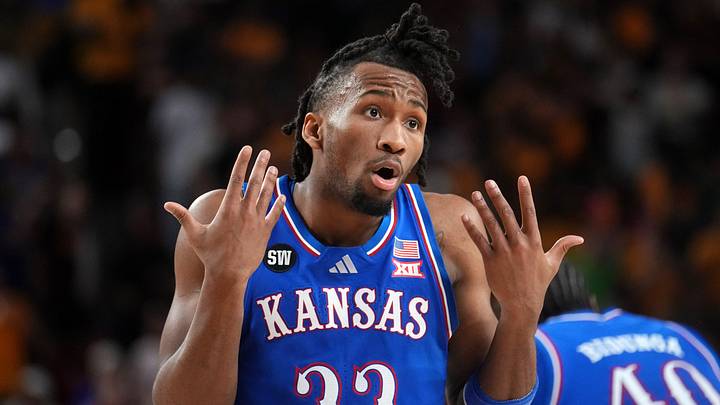
I wanted to keep these exclusively basketball-related. But unfortunately, it would be malpractice not to mention Darryn Peterson's ever-so-discussed health concerns. Throughout his freshman season at Kansas, Peterson was hampered by constant cramping issues, which allegedly stemmed from high doses of creatine.
While Peterson appeared in 24 games with the Jayhawks, he often left games after the first half. The risk of further soft tissue injuries is a concern. It's also vital to note that Peterson was zapped of some of his burst and athleticism due to these injuries. Should this trend continue, he might not be able to operate as the lead creator one would like him to.
A fully healthy Peterson would likely be the top pick, but his constant injury problems make him more of a mystery box than the surefire star guard he looked like at this time last year.
Cameron Boozer: Athleticism

Cameron Boozer is a near-perfect basketball player. If there's one thing that holds him back, though, it's his lack of athleticism. Boozer isn't an explosive leaper, nor is he particularly flexible or quick. Defensively, this impacts both his rim protection and switchability, while offensively, this makes him more reliant on his bruising and general craft to score.
You'd generally like to see more traditional athleticism from a four-five tweener like Boozer. With that being said, this falls on the lower end of concerns for me personally, given Boozer's stellar feel for the game and two-way impact. His lack of athleticism might make him untraditionally successful, but I think he's poised for success nonetheless.
Caleb Wilson: Shooting

With elite athleticism, size and length, Caleb Wilson is a tantalizing two-way prospect. However, his 3-point shot is a glaring red flag. The North Carolina big man shot 7-for-27 on his attempts from deep range, which translates to a paltry 25.9 percent.
Should this flaw not improve the optionality of lineups around Wilson, it will become more limited. Playing one non-shooter is fine, but two can be a nightmare, especially in the playoffs. Given the rarity of stretch fives, it's worth wondering if Wilson will be able to play more of a center at the NBA level for this reason. If not, he will have to compensate with other skills in a big way to make up for his lack of shooting.
Mikel Brown Jr.: Decision-making

In many ways, Mikel Brown Jr. is an ideal modern-day guard. The Louisville product offers plus-size, difficult shot-making and dynamic playmaking. There's no denying that he is an erratic decision-maker, though. This can be seen both from his daring passes and ill-advised shots. It's worth noting that he shot just 41 percent from the field and averaged 3.1 turnovers to 4.7 assists.
I still think Brown can be a star-level player without improving this issue a ton -- look at LaMelo Ball. Nevertheless, this proposition banks on Brown being an elite shot-maker and passer. While that's possible, a more sinister reality exists where Brown proves that he isn't an elite at these skills in an NBA context and in turn, his unpredictable decision-making derails his career in a real way.
Keaton Wagler: Athleticism

You probably saw this one coming, right? Keaton Wagler is a smooth operator and gifted scorer, especially outside of the paint. At the same time, Wagler somewhat infamously didn't record a single dunk during his lone season at Illinois, which is particularly concerning given his plus positional size at 6-foot-5 barefoot.
Wagler's lack of athleticism (and wiry frame) contributed to subpar finishing around the rim; specifically, he shot 57.6 percent at the rim per Draftballr. Furthermore, while he has a deep offensive bag, he doesn't have a quick first step, something that could hinder him at the next level. This could also impact his one-on-one defense.
Wagler's self-creation and high feel are more than enough for me to buy into him. Yet, if there's a world where he flops in the NBA, it will undoubtedly be connected to his athleticism.
Darius Acuff Jr.: Defense

Unfortunately, this one is far too easy. If you've spent much time on NBA Draft Twitter, you would know that Arkansas guard Darius Acuff Jr. is a divisive prospect due to his lackluster defense. There's no sugarcoating it: Acuff was a bad defender in college. He was routinely out of position, wasn't engaged off the ball and didn't hold his own on the ball.
While his plus wingspan and stocky frame could help turn things around, Acuff's defense is an undeniable weakness and at 6-foot-2, he doesn't have optimal size. If he can't improve significantly on defense, the question is whether his impressive offensive skill set will be good enough to cover up this flaw.
Kingston Flemings: Size

Kingston Flemings was listed at 6-foot-2.5 barefoot and 183 pounds at the combine. While that's not ideal, perhaps the bigger concern was that his wingspan came in at 6-foot-3.5. Since 2019, just four players (Rob Dillingham, Jared McCain, Reed Sheappard and Tyler Herro) have been drafted in the first-round with a wingspan below 6-foot-4.
With Houston, Flemings proved to be a plus defender. Even still, from both a size and length standpoint, his measurements are far from ideal for an NBA guard. Flemings' blazing speed and general poise can help him overcome his subpar size, but his NBA success would be unprecedented from a size perspective.
Aday Mara: Conditioning

Michigan big man Aday Mara offers an intriguing blend of size and feel for the game. He projects to be an impactful rim protector on defense and play-finisher with upside as a passer on offense. The big worry with the 7-foot-3 giant is that he might be unable to handle a heavy minute load due to his conditioning. With the Wolverines this past season, he averaged just 23.4 minutes.
And given his outlier size, he's not all that mobile. Thankfully, we have seen Donovan Clingan, a similarly sized center, work through this same problem, but conditioning remains a chief concern with Mara's NBA projection.
Nate Ament: Inefficient scoring profile

Frankly, not a whole lot went right for Nate Ament during his lone season at Tennessee. If I had to sum up the biggest concerns with Ament, I would broadly settle for general inefficiency. He shot 39.9 percent from the field and 33.3 percent from deep range in college, numbers that can't continue for him to be a positive offensive player at the next level.
The most concerning part of Ament's struggles is that, despite being 6-foot-10, he didn't finish well around the rim, shooting just 51.8 percent on such shots -- a number that ranks in the fourth percentile. Ament does have a solid handle, especially for his size, but he struggled mightily to finish through contact. He is extremely spindly, which undoubtedly contributed to his struggles with physicality. This, paired with inconsistent 3-point shooting, makes it tough to project an NBA role for Ament without adequate improvement.
I do see real value in gambling on a former top-five recruit, but I would expect his impact to mainly be felt on defense and it could be a long journey for his offensive game to improve.
Brayden Burries: Lack of lead guard capabilities

Arizona guard Brayden Burries is a jack-of-all-trades player without any glaring flaws. Nonetheless, it's fair to suggest that he projects to be a complementary off-guard with limited star upside. Every team could use a player like this, but Burries isn't a true lead guard; as a creator and playmaker, he's a step behind.
Burries scores while within the flow of the offense, but isn't a high-end self-creator like the other lottery pick guards. Furthermore, he doesn't organize offense like a traditional lead guard; he instead thrives as a connective playmaker. To me, Burries feels destined for a long and fruitful career as a role player, but doesn't have the same top-tier star outcomes one would hope for from a lottery pick.
Karim Lopez: Lack of bankable NBA skills

I've struggled to get on board the Karim Lopez hype train. Sure, he has prototypical NBA size and is a good rebounder with a solid motor, but outside of this, there's not much to bank on. Plus, Lopez isn't a great athlete by any means.
Now, one could argue that he's a classic do-it-all forward. Typically, I'd be on board with such a player. However, Lopez is inconsistent across the board from shooting, playmaking, defense and creation. You can see some real flashes in all of these areas, but nothing consistent enough for Lopez to have a true signature skill.
Betting on Lopez as a project player isn't the worst idea in the world, but I struggle to see how he gets on an NBA court early in his career.
Labaron Philon Jr.: Thin frame

The NBA is trending toward being a more physical league. As such, slender guards have struggled as of late, particularly early in their careers. Rob Dillingham, the 2024 lottery pick, who is immensely skilled yet incredibly thin, is the most extreme example.
Unfortunately, it's fair to have this same concern with Alabama guard Labaron Philon Jr., who is just 176 pounds. Philon has fantastic handles and his blend of playmaking and shooting gives him combo guard upside. He also averaged a solid 8.7 rim attempts this past season, which offers some promise that he can negate concerns about his thin frame.
Even still, the NBA is becoming increasingly more challenging for thin-framed guards. Defensively, they are hunted relentlessly and offensively, it's extremely tough to get to their spots. Without a doubt, this is a major concern for Philon's NBA projection.
Yaxel Lendeborg: Age

Much has been made about Yaxel Lendeborg's age, as the Michigan forward will turn 24 before setting foot on an NBA court. He is indeed slightly older than players such as Jonathan Kuminga, Paolo Banchero and Josh Giddey. Lendeborg's age isn't a deal-breaker for me as he offers plenty of value, especially as a versatile and disruptive defender.
Still, I do worry that not being the most athletic and strongest player on the court at all times will limit his offensive impact. He already wasn't an elite half-court creator, nor was he a mega-consistent outside shooter in college. At the very least, it's undeniable that Lendeborg's age limits his ceiling at some level.
More NBA news and analysis:
 Add us as a preferred source on Google